
In the Round Room of the Mansion House just over a century ago, fervent discussion was taking place over the birth of a new Irish state. During the heated Treaty debates of 1922 over the document that would ultimately establish the Irish Free State, the same argument was reiterated time and again by an incensed opposition led by Éamonn de Valera: the Anglo-Irish Treaty simply did not go far enough to grant the independence thousands had shed blood for. And ultimately, there was much truth to this point. Ireland was being offered dominion status, rather than full independence, from its British colonisers, and members of the Dáil would still have to swear an oath of allegiance to the King (interestingly, the partition of the island did not feature much in the discourse but, regardless, was still an issue of resentment amongst many republicans). In response to these qualms, Michael Collins (who had acted as one of the central negotiators of the agreement) made the central argument that whilst the Treaty had not fully fulfilled the nationalist ideals so many Irish men and women had dreamt of for centuries, it did act as a “stepping stone” to achieve such goals. And in the end, he would be proven correct when, just under thirty years later, in 1949, Ireland inaugurated itself as an independent republic.
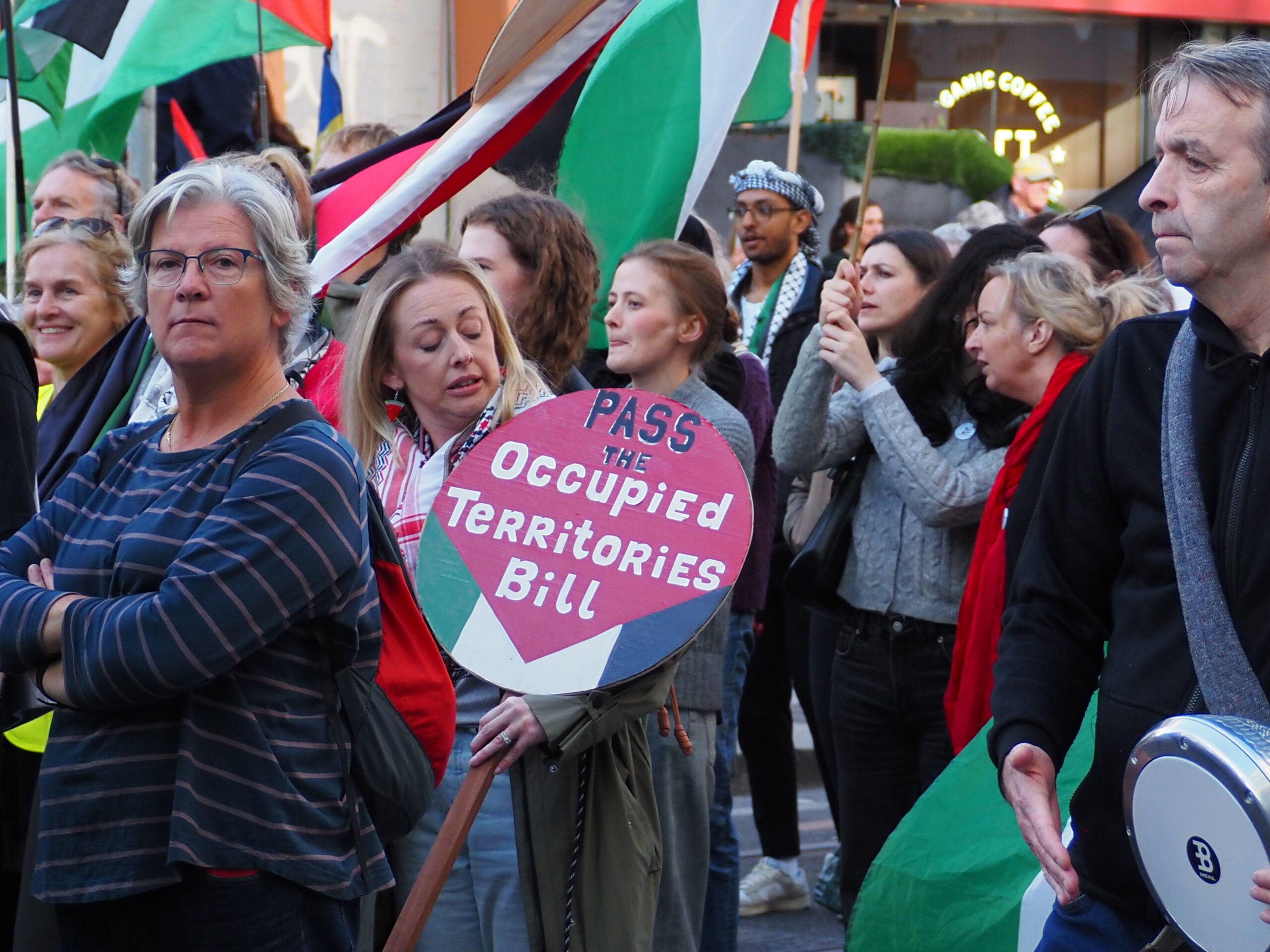
And with this perspective in mind, it is worth examining the credentials of the Israeli Settlements in the Occupied Palestinian Territory (Prohibition of Importation of Goods) Bill 2026 signed into law by President Catherine Connolly this week. In its twelve pages, the Bill sets out measures to sanction trade from Israeli settlements in the Occupied Palestinian Territories, referring to those areas captured by the Israeli forces during the Six-Day War in 1967, including the West Bank, the Gaza Strip, and East Jerusalem. The first version of the Bill was initiated by independent Senator Frances Black in 2018 but faced opposition from the Fine Gael-led government at the time. The Bill was thus stalled until a renewal of interest in the legislation after the International Court of Justice issued an advisory opinion stating that Israel’s occupation and subsequent settlements in Palestinian territory were illegal. In 2025, the original Bill was scrapped and replaced by the current government, with the most significant amendment being the removal of services from the Bill’s text. After further delay, the Bill was finally enacted in its current form and has now been transposed into Irish law.
Regardless of the symbolic value of the Bill, however, it has been extensively criticised for its non-inclusion of services. In a recent interview with the Irish Times, Senator Black spoke about her own grievances with her Bill’s dilution, noting that 70% of trade between Ireland and the Occupied Territories was in services and affirmed that she would continue to push for its inclusion in the future. The Government’s justification for this notable absence in the provisions pertained to its own confidential legal advice. It repeatedly stated that the inclusion of services in the Bill would be incompatible with EU law, as trade is an exclusive competence of the bloc (they have highlighted, however, that there is a public policy exception for goods solely). They have further noted the difficulties of placing sanctions on services given their intangible nature, and have ultimately advocated for further measures to be implemented at the EU-level rather than domestically. A number of academics specialising in EU law have challenged this stance, and it is notable that Minister for Foreign Affairs Helen McEntee has implied in Oireachtas debates that the Bill does not achieve full compliance with the ICJ’s Opinion.

It is indeed regrettable that a pioneering piece of legislation falls short of reaching its full potential, and instead has been hollowed out by ambiguous concerns justified by mystical legal advice (it should be highlighted that the Attorney General’s advice remains confidential out of custom, but it nonetheless prevents true engagement with the Government’s arguments). But this voodoo politics should not act as a complete dampener on an act which represents a cemented stance against the actions of the Israeli government. As a country with an identity built around a history of oppression by a foreign occupier, Ireland continuously goes against the grain by standing against the persecution of the Palestinian people. It was the first member of the European Economic Community to call for a sovereign Palestinian state, a legacy it honoured by recognising the State of Palestine two years ago. The Bill itself is the first-of-its-kind within the EU, and countries within the bloc are following suit, with the likes of Spain, Norway, and the Netherlands progressing legislation on the issue. It should be highlighted that the Bill faced pressure not only from the Israeli Government but also senior American politicians, including the U.S. Ambassador to Israel who described the Bill as an act of “diplomatic intoxication”. Furthermore, the Government continues to advocate for EU-wide level sanctions on Israeli settlements in the Occupied Territories, a position it is likely to accelerate as it takes on the EU Presidency. It is critical that the Bill is extensively scrutinised for its shortcomings, but it also must be examined for its influential impact.
There is no doubting that the Occupied Territories Bill was passed with a sizable asterisk next to its title. Regardless, the Bill has imported the issue of the Occupied Territories into the international political zeitgeist, inspiring other nations to follow suit in sanctioning Israel. The Bill should not be judged solely for its limitations, but also should be acknowledged for its part in the wider objective of holding the Israeli government accountable. Much like the Anglo-Irish Treaty, we perhaps will not realise the true extent of its effects until sometime in the future. It therefore should not be seen as a retreat, but as a stepping stone towards something much greater in the future.