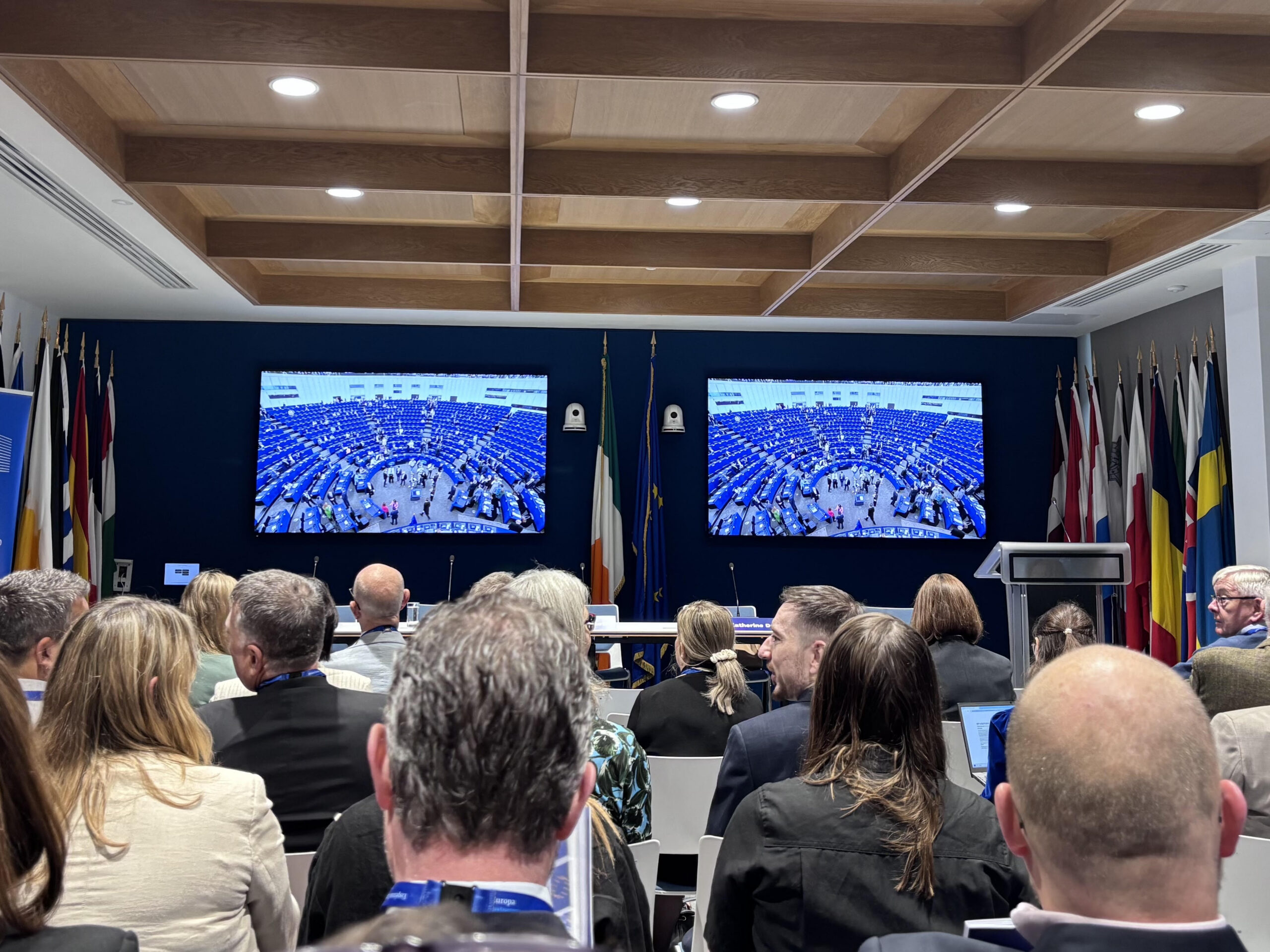

“The state of our Union is the strongest it has ever been. The state of our Union can also feel as precarious as it has ever been.”
These were the words Ursula von der Leyen opened her annual State of the Union address with, highlighting a deliberate tension. That framing, strength and fragility side by side, set the mood for the whole address, which moved almost immediately into geopolitics.
“For some, the answer is to go it alone. But this is not an option for us.” No country named. None needed. Then came the offer. Canada as the EU’s first-ever associate member, an alliance built on a common economic security space, cooperation in tech, and integrated defence industrial bases. Canadian Prime Minister Mark Carney received a standing ovation as guest of honour. Although nothing named Washington directly, this extremely public, and unprecedented announcement definitely set off alarm bells in Washington, as Trump’s tariff war with Canada is ever-ongoing.

Security ran through the whole address. Von der Leyen proposed an Emergency Security Protocol, described as Europe’s own “NATO Article 4,” that would see all Member States convene when one is triggered, plus a European Security Council working with Canada, Norway, the UK and Ukraine, and a European Instrument for Strategic Enablers to build out air and missile defence, strategic transport, and cyber capability.
On Ukraine, she framed the war as existential for Europe too. Ukrainians “are also fighting for our freedom and our self-determination.” She affirmed that support for Ukraine would continue to be guaranteed through a fresh programme funding joint Ukrainian-European companies through remaining SAFE money, continued sanctions pressure on Russia, and support through the winter with humanitarian aid and energy.
For students, the Kids Act hits closer to home. Following countries like Australia, the European Commission has proposed no social media under 13, parent-supervised only for 13-15s with a time limit of one hour a day, and a mandatory safe design for every under-18 account. Von der Leyen called it resisting “a great capture of our children.” A Digital Fairness Act on addictive design is due to be proposed this autumn.
On the Middle East, she called Israel’s E1 settlement expansion “illegal” and “unacceptable,” conceded EU disunity had limited the bloc’s response, and reaffirmed a two-state solution alongside Israel’s right to self-defence.
Also announced were a Mediterranean Youth Skills and Jobs initiative, as well as a Congress of Europe next year marking 70 years since the Treaty of Rome.