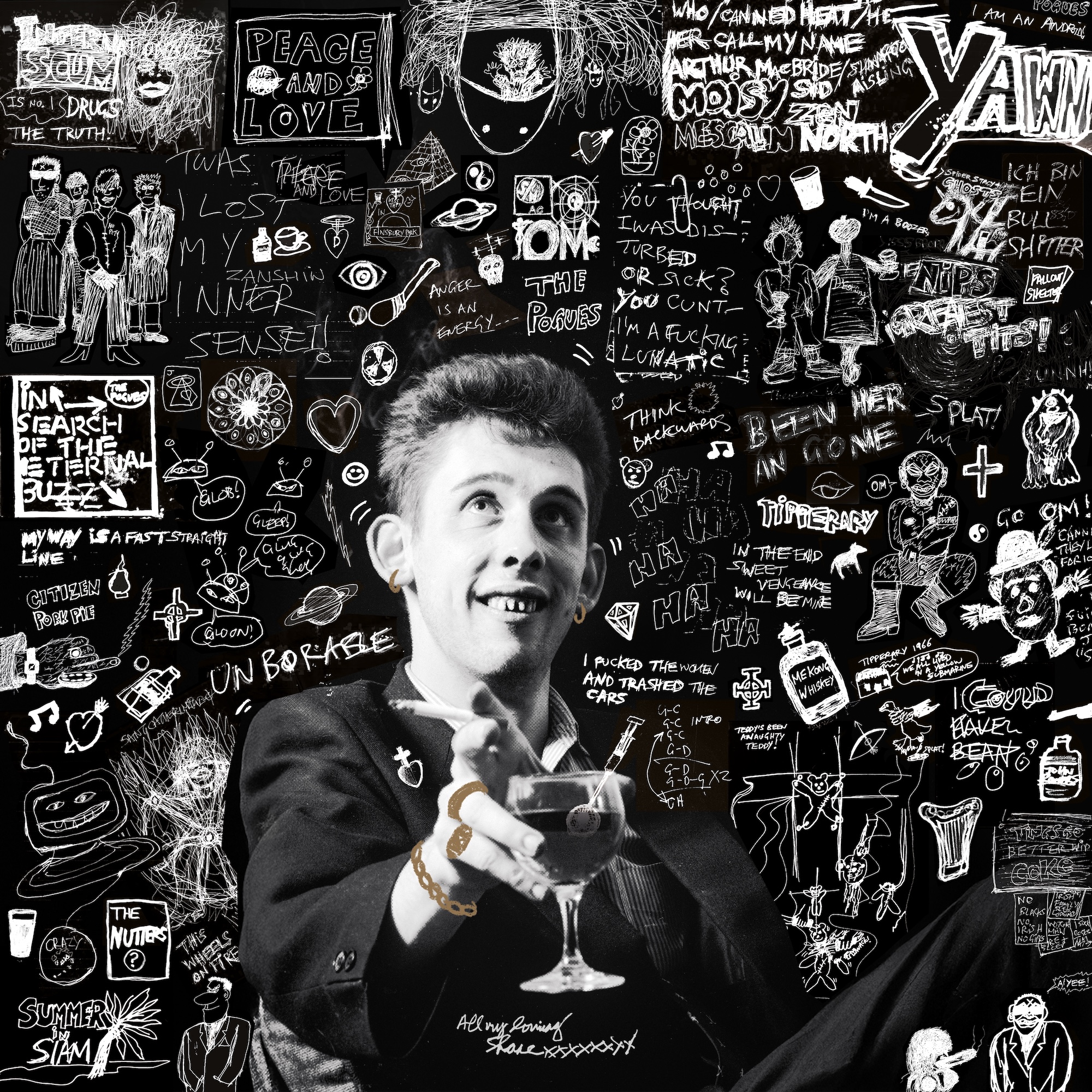

Camille O’Sullivan has long built a reputation as one of Ireland’s most singular artists. Specialising in French chanson and theatrical cabaret, her spellbinding voice and dramatic flair have earned her widespread acclaim. While her repertoire spans the work of Nick Cave, David Bowie, and Radiohead, it is her intimate connection to Shane MacGowan’s songs that earned the French-Irish chanteuse a spot on the forthcoming tribute album, 20th Century Paddy.
Born in London to a French mother and an Irish father, O’Sullivan possesses a unique perspective when it comes to understanding MacGowan’s nuanced sense of identity. “I was born in London, but moved to the nationalist village of Passage West outside Cork. I didn’t know if I was Irish or English or what I was, so I understand that yearning for something that you belong to.”
With refreshing openness and a sharp, dry wit, O’Sullivan paints a vivid picture of MacGowan’s less-than-ordinary life. She begins with her initial encounter with his music as a teenager. “When I was around fourteen, a German boy, Marcus, gave me a mixtape. There were three songs on it that transformed me – A Rainy Night in Soho, A Pair of Brown Eyes, and Elvis Costello’s I Want You. I was like, what is this? It sounds Irish, but there’s something really sad, beautiful and haunting, even though it’s quite traditional.”

“When I came up to Dublin, I listened to more of their music, and then I heard Fairytale of New York. And I said, “Who is this person who could create that?” Then, in college, I’d always laugh because they’d have the posters: “See Shane MacGowan for the last time alive!” – and I’d go, what does that mean? So, he was already an enigmatic figure in my mind.”
Her eventual meeting with MacGowan was as impromptu as it was iconic. “I was an architecture student at a Christmas party when I got a phone call from Victoria [MacGowan’s partner]. She said, “Would you like to sing with Shane?” and I said that I’d love to. She said, “It’s in fifteen minutes in the Olympia.” I gobbled down my Christmas pie. I knew the chorus of Fairytale, but I didn’t know the verses. So, I had to learn them while cycling down there, and that’s how I met Shane. I had no introduction and no chance to rehearse it. It was the most amazing moment for me.”
“So, that was the beginning. Then, I got this lovely invite to tour with Shane and Sharon Shannon. I always used to have these traumatic situations whenever he asked me to do a gig. I remember I was sitting in A&E, ready to go in and meet the doctors, when I got a call saying, “Do you want to sing with Shane on the Late Late Show?” I said to the nurse, “I might be back tomorrow!” The host said, “I never thought that out of the two of you, you’d be the one ending up in the hospital!” It was slowly becoming a friendship.”
O’Sullivan retains a vivid recollection of the ferocious passion experienced at the Pogues’ live shows. By celebrating the outsiders, drinkers, and dreamers, MacGowan tapped into something visceral. “When I toured with him, I remember thinking that there was an anarchy on stage that every musician should learn from. It was wild – like their life depended on it. No wonder people were crazed at his gigs – what they created was magic. It’s what Irish people are known for – that we have this wildness.”
“Later on, I toured for the 25th anniversary of Rum Sodomy & the Lash. That was mind-blowing – I’ll be in a nursing home remembering that moment. I remember watching him in Brixton, and I was bawling my eyes out because he was singing Rainy Night. I thought, how did I get from that girl in boarding school to be standing so close to the man who wrote my favourite songs? I felt so moved for the girl of the past but also watching the ferocious crowd. They looked like Vikings to me; they knew every word. Shane’s audiences were febrile. He gave a voice to people in a way Irish people never had before. It felt tribal, and it felt spiritual.”
Touring with MacGowan and his cohort meant there was rarely a dull moment. “One of them had written a book about whether Shane was an eejit or a genius. At breakfast, Shane would sit with the book, looking at the writer. I thought, this is a fascinating breakfast. I’m not sure if anyone gets on in this group.”
“At that stage, his daughter was singing Fairytale. He rang me and said, “She can’t do it because she’s pregnant. Can you do the London O2?” And I was sitting there, pregnant myself, going “absolutely!” It was magical. There were twenty thousand people there, with the snow coming down.”
O’Sullivan’s affection for MacGowan stems from understanding him far beyond the caricature of a rowdy punk poet. “He was a very different person off-stage to the person on stage – more like a little boy. He could annihilate many people with his “keep out of my way” – but he did it to protect himself. He was genuinely a very clever, loving person. Shane didn’t drink when he was on tour, but he’d pretend he did. At his birthday in the cricket club, my partner Aidan was probably more drunk than he was!”
“He was authentic. What you saw was what you got. I felt very cherished and loved by him, and I really loved him as a person. I tried to see Shane without all the accolades of what he’d done in music. Because it must be exhausting to be this iconic person – maybe you just want to relax. But through Victoria, who is such a beautiful person herself, we were able to sustain quite a normal friendship. Aidan and I feel privileged that we had that.”
Beyond his reputation as a lyricist, O’Sullivan is equally eager to highlight MacGowan’s underappreciated vocal prowess. “He was one of the best singers of our generation. For his sixtieth birthday, we were all given songs to sing. I thought this was going to be terrible because we were either going to be literal – pretending to be Shane MacGowan and sounding like a bad wedding band – or we weren’t going to hit our mark. He owned his songs as Dylan owned them. I thought, we’re doomed trying to reach his level.”
“Two days before he passed away, we were in hospital, and he said to me, ‘I loved singing with you, Camille, but I always felt like a traitor to Kirsty [MacColl].’” And I said, “I understand that – I felt the same.”
“When he passed, Mundy and I were asked to sing Haunted. I remember going down in the car, very nervous, and Feargal Murray said – ‘you’re saying goodbye to your friend: that’s all you’re doing.’ I was so scared to mess up the lyrics on TV. I remember looking at the coffin and thinking, what would Shane do? He’d just go for it. It was as a Shane MacGowan evening should be.”
In the period of mourning that followed, her appreciation for his craftsmanship deepened further. “When Shane died, I couldn’t listen to the music. I was just devastated. I thought, I’ll just read his music. It was so comforting, and it unlocked something in me. I never knew how to sing his songs until I read the lyrics. I was just crying my eyes out. It’s as good as Kavanagh or Heaney, if not better.”
Her resolve to honour MacGowan’s legacy was only strengthened by the strangest quirk of fate. “I was coming back through Dublin Airport from something to do with Shane after he died. I bumped into Marcus, who gave me the mixtape, who I hadn’t seen in forty years, and who lives in Germany. You don’t believe in ghosts, but I was like, Shane, ghosts, angels…”
That sense of fate fuelled her desire to record his songs herself, alongside her participation in this star-studded compilation. “I decided I wanted to record all his songs and go on tour. Whether we get audiences or not doesn’t matter, because I’m doing it as a personal thing for the little girl who was fourteen. This is what made me become a singer. My album is recorded, but because of Victoria’s album, I’m thinking I’ve spent a fortune on that album, and my dog and the cat will probably be the only people who hear it!”
“The fact that Tom Waits, Bruce Springsteen, and U2 are collaborating on the album shows the high esteem Shane was held in all over the world. I was asked to sing Summer in Siam, and I had recorded it. Then I got a text message saying, “Sorry, but Tom Waits wants to do it.” And I laughed – I’m not going to bloody argue! If Tom Waits wants to sing it, I’m leaving it alone!”
“It all worked out for the best. She said, “Do you want to sing You’re the One?” – and I said, “You’re the One is free?” That’s Aidan’s favourite song by the Pogues. He was in the film, Circle of Friends, that that song was written for.”
The song represents a unique departure from MacGowan’s more raucous material in its romanticism and grandeur. “It’s completely different to any other song Shane had written. It’s more like a Hallmark song in its sentimentality and its sweetness. There’s a hymnal quality to the work. That’s the beauty of a song – you can be with somebody for four minutes every night.”
“It’s got a little bit of history for me – at his sixtieth birthday, the last song I heard Sinéad O’Connor sing was that. We were hanging out; she was smoking and hiding behind the trees. Nick Cave’s assistant was pointing at us and probably saying, “Make sure you don’t talk to those two nutters over there.” Shane was in a wheelchair. He sang Will Ye Go, Lassie, Go? and it brought the house down. It was such an honour to him that the President saluted him that day.” In years past, she explains, the Pogues had faced sharp dismissal from music traditionalists and the Irish cultural establishment.
“I can’t wait for the album. I’m so excited, when you look at the names – I look like a headliner with my name below Bruce Springsteen. Thank God we went in alphabetical order!”
20th Century Paddy releases on the 13th of November. Camille O’Sullivan plays the Shorelines Festival, Kilkenny, Galway, and Cork before her headline gig featuring Earl Slick, titled The Art of Falling Apart, at the Olympia Theatre on the 21st of November.