
If, like a certain part of the Trinity Population, you do not have the luxury of coming from Dublin, or having elder siblings that went to this college, you might envision Freshers’ Week as seven days spent clubbing, exploring the campus and Dublin with your new best friends for life and joining all of the amazing societies you’re so passionate about. You buy tickets for almost every event advertised on the Ents Instagram. Freshers’ Week starts, and you go to said events. You realise you can’t get a drink for under €6. You realise Dublin clubs (or at least the ones where said events take place) are shit. Along with your flatmates, you solemnly swear to never go to any paid Ents events ever. You bond over this, sipping Budweiser bought with a Lidl Plus discount in your Halls kitchen.
This is my Freshers’ Week experience, and I remember it fondly, but one must wonder where all these people posting surf trip photos, or aesthetic candids from a new niche brunch spot around town every day come from. While Freshers’ Week does a great job with exposing incoming first-years to countless opportunities, from friends to societies to sports clubs to pub crawls, the way in which students experience it differs vastly across the Trinity population.
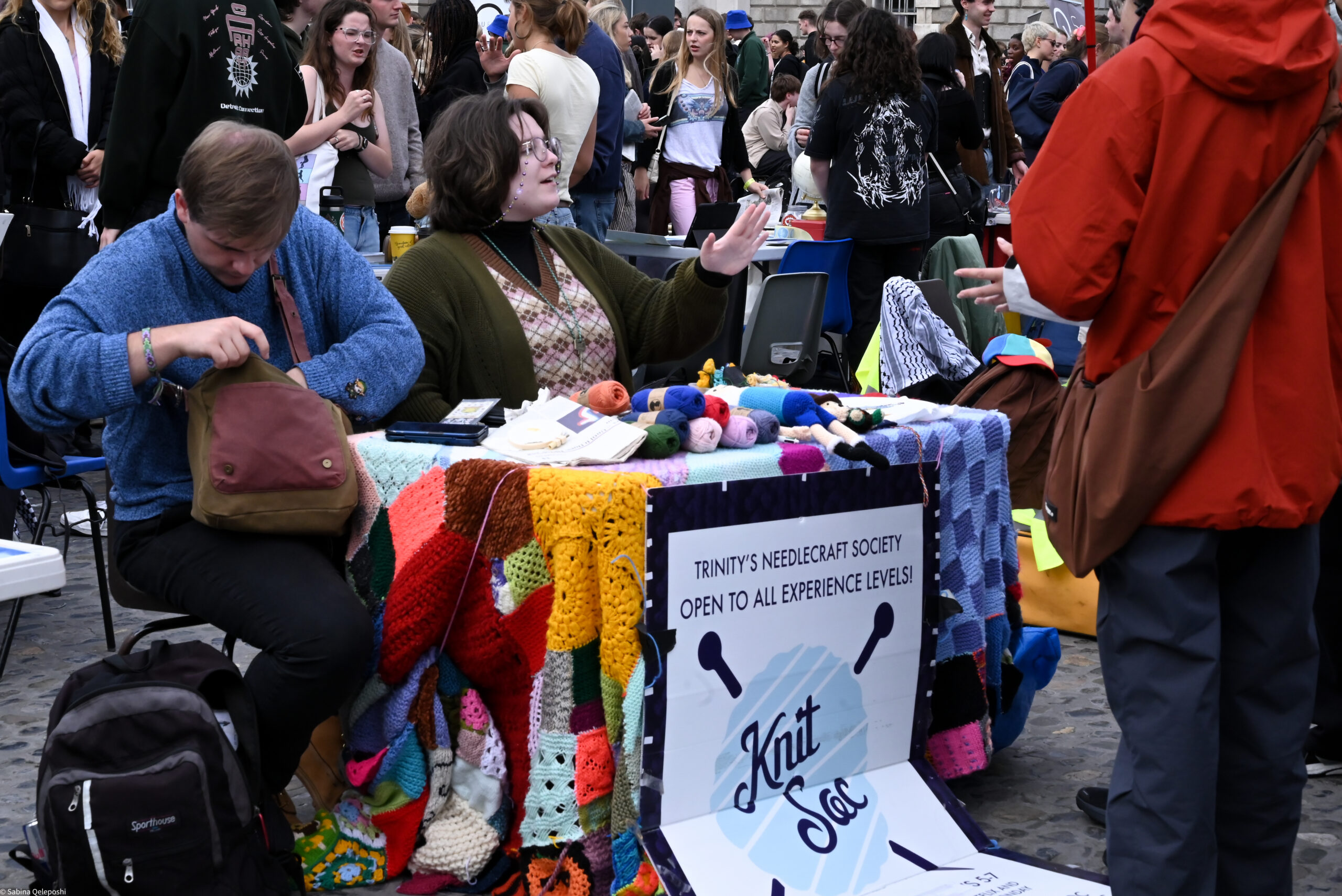
Some events, like the Freshers’ Fair, are very useful. They are free, easy to access, provide a great opportunity to meet “like-minded people” and give students a taste of what each society has to offer them. For example, upon finding out that the ski trip costs €569, I myself quickly realised that DU Snowsports has nothing to offer me. Spending some time around Trinity, you quickly start to notice how different societies cater to different demographics. You might not have a chance for a Phil career, not even because of the school you went to, but because you will be too scared to walk through that door.

The daytime events around campus are quite nice as well. They are usually free, make a really good pretext to spend some time with the new people you’ve just met, and to get to know the society committees. But where the financial privilege ceases to play a role, there is also the privilege of knowledge. The JFs who have older siblings or older friends have a certain amount of obscure insights, such as: “My brother said we should definitely go to the Wind Wave Rave, he’ll get us tickets” or “I already know I want to act in Co-Op and then do sound design in second term”. These arcane secrets, unavailable to complete newcomers, do make navigating college life easier. But hearing them be passed around, while only just trying to figure out what “the Pav” is, is also intimidating — whatever you take out of Freshers’ Week, it will be tinged with a sense of overstimulation and served with a side of FOMO.
Trinity’s student population is varied. There are people from Dublin; there are people from outside of Dublin. There are international students like myself, and there are Americans. The Dublin people quickly become friends and are sometimes actually referred to as “the Dublin people”. They know each other from school, from pre-school, from walks around Rathmines. Some have friend groups carried on from high school, or even earlier. They have their favourite spots and activities in town, and for them, Freshers’ Week carries a lot less pressure — the stakes are lower. A lot of Irish people also know each other from the Gaeltacht. Like a lot. The Americans also quickly become friends with each other, because they live in Kav, and because they are American. Apart from this, it’s up to you to “find your people”, and Freshers’ Week is supposed to help.
When you meet someone at the Freshers’ Fair, the crucial next step in strengthening your potential future friendship is a shared activity. The most common ones include “getting coffee”, “getting food” or “getting drinks”. The first one is quite safe — you can get away with a €4 flat white at Beanhive and say you’re “not hungry”. The other two will cost you anything from €13 at Sprout to — I actually don’t know what the higher end of this spectrum is, or whether it exists at all. It is hard(er) to make friends when you can only afford a certain number of hangouts per week. If you have to chug vodka alone on the way to an event to avoid the cost of €7 (per unit) predrinks you were invited to. If you have to trek back to Halls midway through the day because you forgot your meal-prepped pasta.
My public school, back home, was attended by some rich people. But the more time I spent talking to fellow Freshers, the more muddled my definition of “rich” became. Some people had already planned trips to Paris, London, or Berlin, and not budget trips, mind you, every weekend up till December. Others sported handbags the price of which I could not believe in, or casually offered to buy shots for the whole friend group, multiple times a night. Some people paid €22,580 for their tuition and called it “cheap” compared to what they would’ve paid at home. Some of these same people went to high schools which cost the equivalent of €60,000. Per year. For 12 years.
However bitter I may sound, I do not want to say that Freshers’ Week should be abolished because it is revealing of the deeper class inequalities that lie within the Trinity Student body, which it is. But which part of college life isn’t? These inequalities exist, whether Freshers’ Week does or not. You’d still be faced with the “to walk home for 40 minutes, at 3 am, very drunk, in the pouring rain, or to order a €35 Uber” dilemma if Freshers’ Week wasn’t a thing.
Nevertheless, most people do find friends in college. Usually, their friends are either from a similar tax bracket, or they’re empathetic, with down-to-earth priorities. After a few months in Dublin, people also find the (now unfortunately closed) €1 coffee in Heartbreak, Pret discounts just before closing time, free entrance into Coppers before 11 pm, and other things which make the college experience more enjoyable. But some people knew these secret tricks all along, and some others never had the need for them.
Freshers’ Week can be overwhelming, and a fair bit of a class and culture shock (“What do you mean, you’ve never been skiing?!”). It acts as an effective filter, helping you decide who you want to spend your time with. And whether that decision is made while bonding over crafts in the Atrium, sharing a slice of free Freshers’ Fair pizza, or going your separate ways due to the price of brunch, it must be said that ultimately, this was always the point of Freshers.