
The Department of Justice has confirmed to the University Times that of the 130 long-stay student visa applications they’d received from Palestinian nationals, 39 have been granted, with 103 refused. This compares to last year, when 122 were accepted, and 22 were refused.
Most of these students hold fully funded scholarships to study at Irish universities, including Trinity. The state’s stated reasons for rejection ranged from insufficient documentation, gaps in education and employment history, and insufficient evidence for intention to return to Gaza upon the completion of their education. Concerned universities, staff representative bodies, and student unions and organisations have identified these refusals as being difficult to reconcile with the prevailing conditions in Gaza. The Department of Justice also confirmed to the University Times that there are no planned changes in their processing procedures and that each application is assessed on its own merits, irrespective of nationality. The material developments to date are as follows.
At the tail end of July, RTÉ reported that of 69 visa applications received from Palestinian nations, only nine had been granted and 27 refused, and the remainder were pending. Trinity Boycott, Divestment, and Sanctions (BDS) Chairperson, Seán Radcliffe, published a guest essay in the University Times describing the actions of the Department of Justice as a “scholasticide.” Within Trinity itself, a student holding a fully funded, five-year engineering scholarship offer worth €38,000 per year was rejected by the Department on financial grounds. Similarly, over 20 other students with fully funded scholarship offers had their visas rejected.

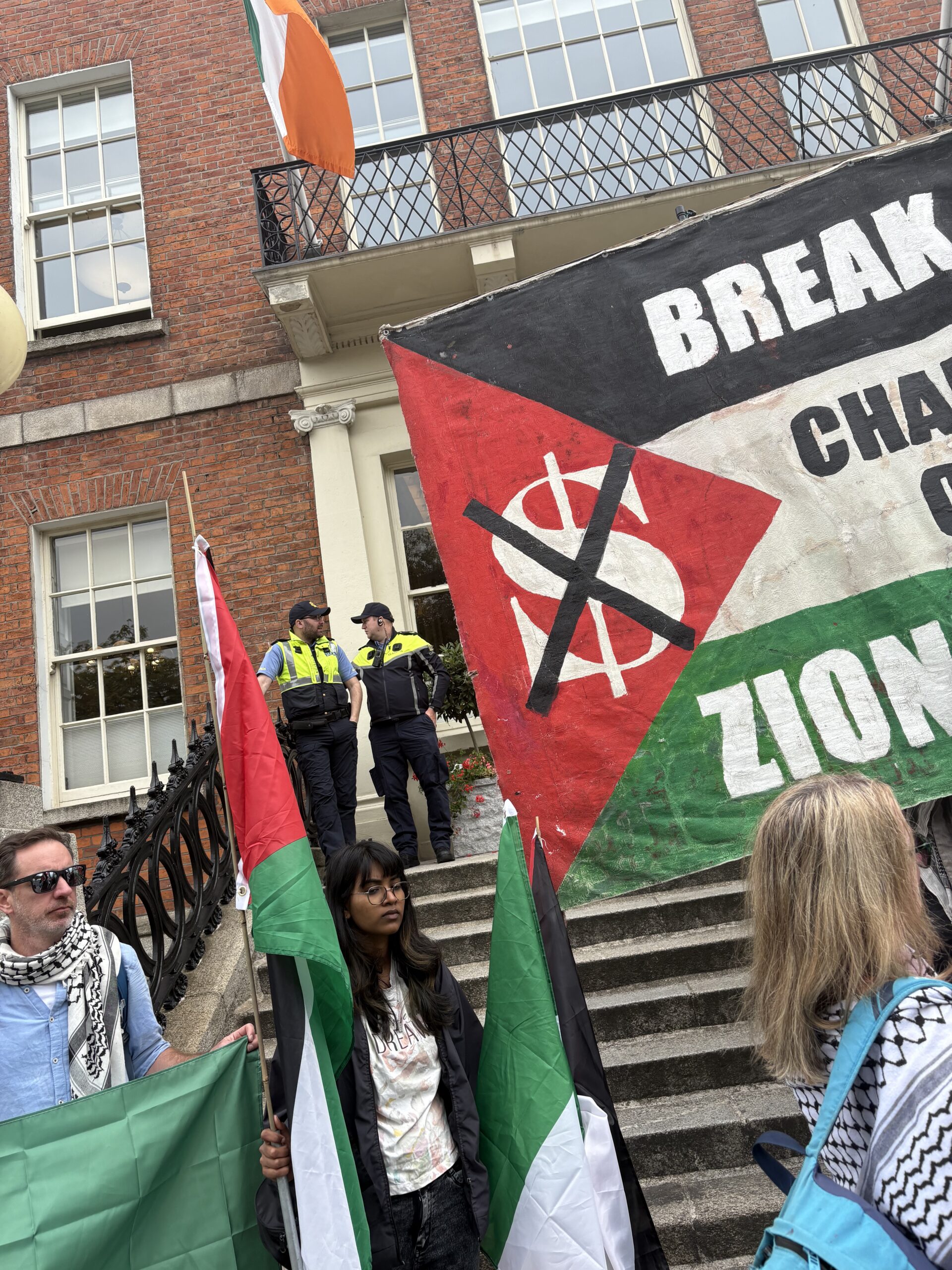
On the morning of July 31st, Trinity’s BDS and the Trinity College Dublin Students’ Union (TCDSU) led a demonstration outside the Department of Justice. On the same day, the Irish Federation of University Teachers (IFUT) was one of the first bodies to comment publicly on the situation. IFUT president, Michael Hinds, described the reported grounds for refusal as “unreasonable” and, in his assessment, “inhumane.” IFUT called on the Government to provide a detailed explanation of its refusal criteria and to resolve the applications of the twenty funded students before the commencement of the academic year.
In an article published by the University Times on August 13th, the Department of Justice confirmed that 24 more long-stay visas were rejected within a week, bringing the cumulative total to 51 refusals and 22 approvals. The Department also confirmed it had no plans to introduce special arrangements for Palestinian applications despite acknowledging the barriers they faced. A follow-up article on August 19th reported that the Department rejected 46 more visas, bringing the total to 97 refusals and 36 approvals. Department spokesperson Ciaran Casey stated that 41 Palestinian nationals were granted visas throughout 2026 and reiterated that entry for Palestinian nationals proceeds through the “existing legal immigration pathways” available to all non-EU nationals, with each application assessed “on its own merit.” Notably, the visa process for visa-free non-EU nationals, such as those from the United States, requires demonstrating a quarter of the amount of cash on hand as those from visa-required countries like Palestine for a four-year degree.
The Irish Times also reported on the case of Ahmed Abuhassan, a 22-year-old computer science student who continued his studies after his university in Gaza was destroyed, working from a tent on borrowed electricity. Mr Abuhassan’s visa application was refused despite University College Dublin having confirmed his tuition, accommodation, and an additional €10000 in annual living costs. The grounds for refusal were insufficient finances, insufficient demonstration of English proficiency, and inadequate evidence of his intention to return to Gaza.
On August 19th, a large protest of around 400 people was held outside the Department of Justice, featuring students’ unions, BDS groups, and political parties. Present also were the leader of the Labour Party, Ivana Bacik, Deputy Leader and spokesperson of the Green Party, Hazel Chu, and Eva Dowling, who spoke to the University Times condemning the Department. A week later, another much smaller protest was held outside the Department once more but lacked any serious organisational presence. University Times also reported the increased number of Garda on the scene.
The Irish Universities Association (IUA), which includes Trinity College Dublin along with other Irish higher education institutions, issued a joint statement wherein its director, Paul Johnson, stated that higher education institutions had supported the Ireland-Palestine Scholarship Programme and appealed to the Government at the earliest indication of an elevated rejection rate. However, the statement did not directly criticise the Department’s actions.
In an Irish Times correspondence, Councillor Hazel Chu called on Minister for Justice, Jim O’Callaghan, to intervene personally. At demonstrations, Minister O’Callaghan and the Department had been dubbed the “Department of Injustice”. In the same edition of the Irish Times, Dr David Woods of University College Cork argued in opposition: university leadership showed insufficient regard for Irish students with rising financial pressures and raised concerns about the implications of more asylum claims. Students’ unions and Trinity BDS are continuing to play an active role in speaking out against the refusals and attempting to provide a voice for Palestinian students.
The Department’s claim that there have been no changes to processing procedures is noted by critics as being a deliberate change in approach, as reflected by the numbers. Additionally, the grounds on which applicants were being rejected were challenged in the statement by IFUT, where the requirements for some applicants are “impossible to satisfy in the current circumstances.”
Outgoing Trinity Vice President for Global Engagement, Emma Stokes, spoke to the University Times in an exclusive interview detailing a sectoral group of university staff picking up seven Gazan students from Dublin Airport on CAO offer day. Stokes said that last year, “Simon Harris was on the airwaves celebrating how his department had been very involved in the evacuation, how we’re welcoming [Gazan students] to higher education institutions in Ireland. And now we have silence.” Stokes added that it was part of “Ireland’s commitment” to make it easier for students from Gaza to enter the country. She continued, “These students aren’t taking other students’ places…they are academically exceptional”. “We did this for Ukraine, we did this last year for Gaza. We can do this better, and we should do it better.”
The dispute places universities in an unusual institutional position. While most frame this issue as a humanitarian one, Dr Woods’ view argues that university leadership is extending itself into immigration policy at the expense of Irish students whose fiscal needs have not been adequately met. The IUA’s refusal to criticise the Government and its policies shows its desire to maintain a working relationship with the Government; other organisations, like those at Trinity, have adopted a more confrontational position.
On September 2nd, another protest was held at the Department where protesters handcuffed themselves to a door. The protest resulted in their arrest.
The story will continue to develop as further appeal decisions are due to fall in the autumn term.