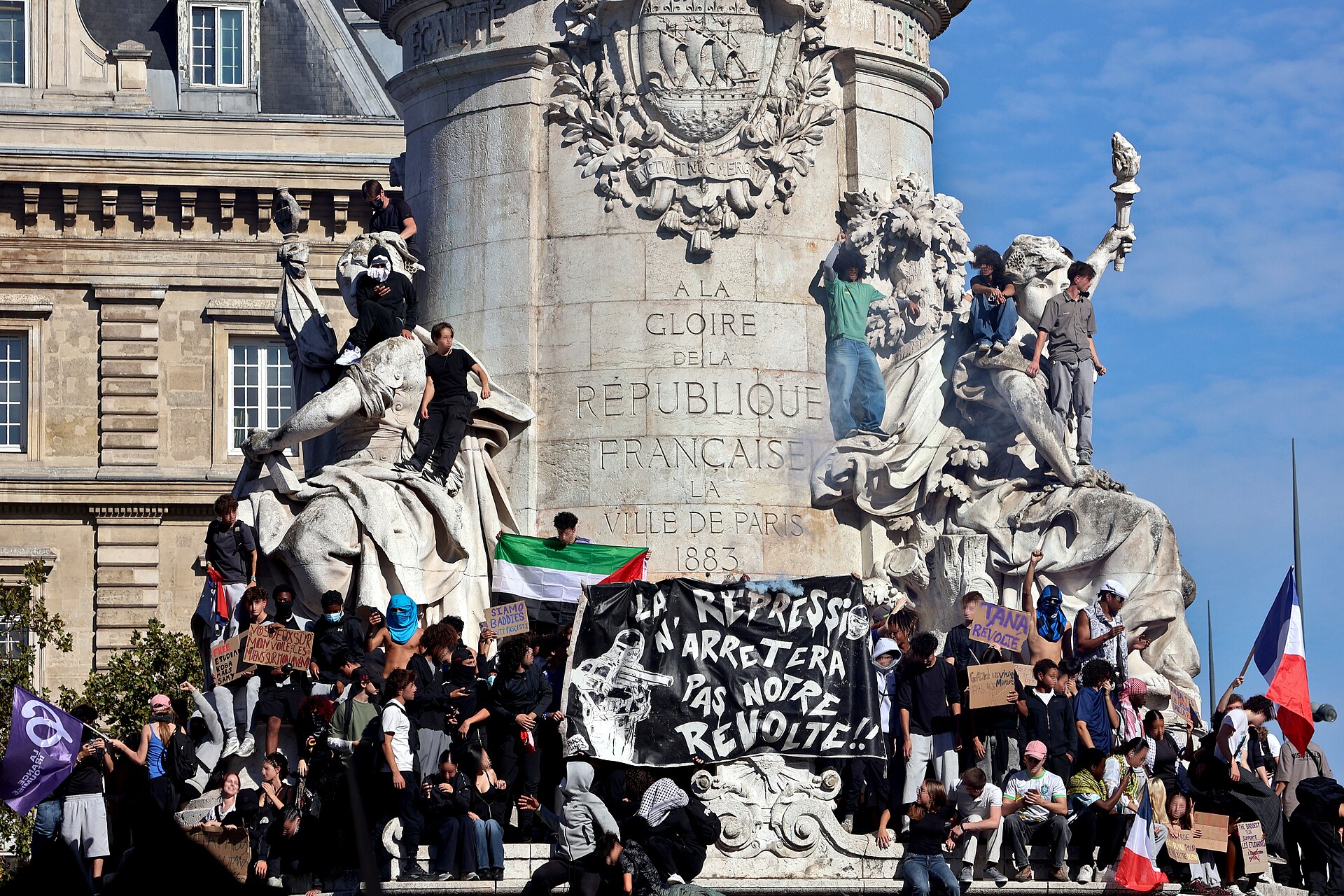

Part of the conservative and right-wing media aligns its semantics with that of the government, qualifying these protests as “riots” or “waves of urban violence”, thus obscuring the political dimension of a student revolt that began on September 21. The movement quickly spread from Seine-Saint-Denis and the Parisian suburbs, areas particularly affected by territorial inequalities in treatment, to the rest of France: higher impoverishment, discrimination, and a lack of humans and technological means. At the root of the anger included overcrowded classes, the thermal decay of buildings (freezing rooms in winter, suffocating in summer), growing uncertainty about the future, and a structural recruitment crisis. Faced with the scale of the movement, teachers, school monitors (AED), and parents joined the blockades to carry their own demands regarding the degradation of public services and to protect teenagers from police charges.
The violence of the state’s response indeed reached a critical threshold. The Ministry of the Interior has recorded hundreds of arrests and police custodies, involving a majority of minors. On social media, evidence of disproportionate interventions accumulated as reported by the National Youth Rights Association. In Tours, a 16-year-old high school student permanently lost the use of an eye following an injury inflicted by riot police with a less-than-lethal riot control weapon at the beginning of the month. On October 5th, in Lens, a 15-year-old had his hand torn off by the explosion of a stingball grenade. In Saint-Ouen-l’Aumône, a 14-year-old had his jaw fractured and several teeth broken by a tear gas grenade fired at point-blank range.
The close-range use of tear gas dispensers or grenades nevertheless presents well-known major clinical risks such as severe burns to the cornea and skin, respiratory distress, etc.

Tensions reached a new level of gravity in Belfort, where an arrest led to major clashes and a fierce legal battle. The events took place in the bed of a river crossing the city, below a park where protesters were gathering. Several videos show a teenager, held by a policeman, trying to keep himself under the water during the arrest. The teenager’s defence prompted the filing of a complaint for “attempted murder” targeting the official but also targeting the Minister of the Interior, Laurent Nuñez, for complicity by instigation.
This version is heavily contested by police unions and the Belfort prosecutor, who stated that the arrest occurred in a stream only 19 centimetres deep. According to them, the officer simply tackled the suspect, who was gathering projectiles, before being beaten on the ground by other protesters, leading to the prosecution of two students for aggravated assault. Faced with these excesses, the executive’s response remains unyielding, with the government refusing to acknowledge police violence and classifying them all as accidents or proportionate responses.
Also, the controversy over law enforcement methods took an explosive turn. Authenticated videos show plainclothes police officers inside the crowds throwing heavy projectiles at their uniformed colleagues. Denounced as a strategy of agents provocateurs, these actions aim to artificially trigger property damage and clashes to justify brutal police charges, legitimise intermediate force weapons, and criminalise a peaceful movement in the eyes of public opinion.
October 6th 2026, however, marked a historic turning point with a massive show of force from the protesters. The streets of major national cities were submerged by a human tide uniting youth, teaching staff, and parents’ confederations. High school and university student organisations claim an exceptional mobilisation of 450,000 protesters across France, including nearly 100,000 for the Paris march alone. Even according to the Ministry of the Interior’s figures, which are traditionally careful, the mobilisation gathered more than 256,000 people across the territory. Universities also began shifting massively into protest, for their own conditions but also to support the younger. Faced with imminent blockades and general fervour, dozens of higher education institutions decreed total administrative closures for the day.
A few months away from the presidential election, the crisis is becoming highly politicised. The leader of Les Républicains, Bruno Retailleau, demanded the banning of the party, La France Insoumise (LFI), a party fascinated by violence according to him. The battle of images is raging. Attempts to criminalise the Left and the youth are contradicted by the reality of the videos. The LFI elected official from Saint-Denis, Bally Bagayoko, was accused by the right of fanning the flames by moving trash cans during the blockade of Paul-Éluard high school. The complete footage broadcast later proves, on the contrary, that he was trying to move flames away from the school gates and to ease tensions between youth and law enforcement.
Left-wing elected officials are accused of stoking hatred and violence among the youth, infantilising them as if they could not rise up on their own, and failing to mention that most elected officials were trying to defuse tensions and protect young people. Yet, state intimidation is directly hitting political representatives on the ground. A communist municipal councillor in Orléans told local media he was thrown to the ground and insulted as “shit” by officers while attempting to defuse provocations. In Caen, local representative Emma Fourreau posted a video showing her being tear-gassed at point-blank range despite wearing her official republican sash.
Similarly, while the right depicts a disconnected and violent youth, numerous scenes immortalised human chains of high school students calmly escorting elderly people or passers-by to help them cross the blockade lines safely, illustrating the maturity and self-organisation of a movement that refuses to let its narrative be dictated.
Prime Minister Sébastien Lecornu played a final political card on October 6th 2026 at the National Assembly. He ordered a rescheduling of timetables at the end of the week to establish a half-day dedicated to an internal democracy session in every high school in France. This measure aimed to open a space for debate where students can articulate their grievances to the administrations. This move was immediately described as completely disconnected by school principals and educational staff unions, who denounced the total improvisation of such an announcement right after days marked by major clashes. For high school organisations, the irony is total: the government pretends to sanctify democracy and empathy inside school gates after systematically repressing, gassing, and jailing outside those who were trying precisely to exercise their most fundamental democratic rights.
It remains to be seen whether this strategy of pacification through debate will succeed in curbing the protest or if the mobilisations will settle in permanently over time. The future of events remains uncertain, especially since the main student unions refuse to yield to the ministerial calendar and continue to actively call for the extension of the mobilisation in higher education. Between the anger of the youth as well as the pressure from union organisations, the standoff may have only just begun.