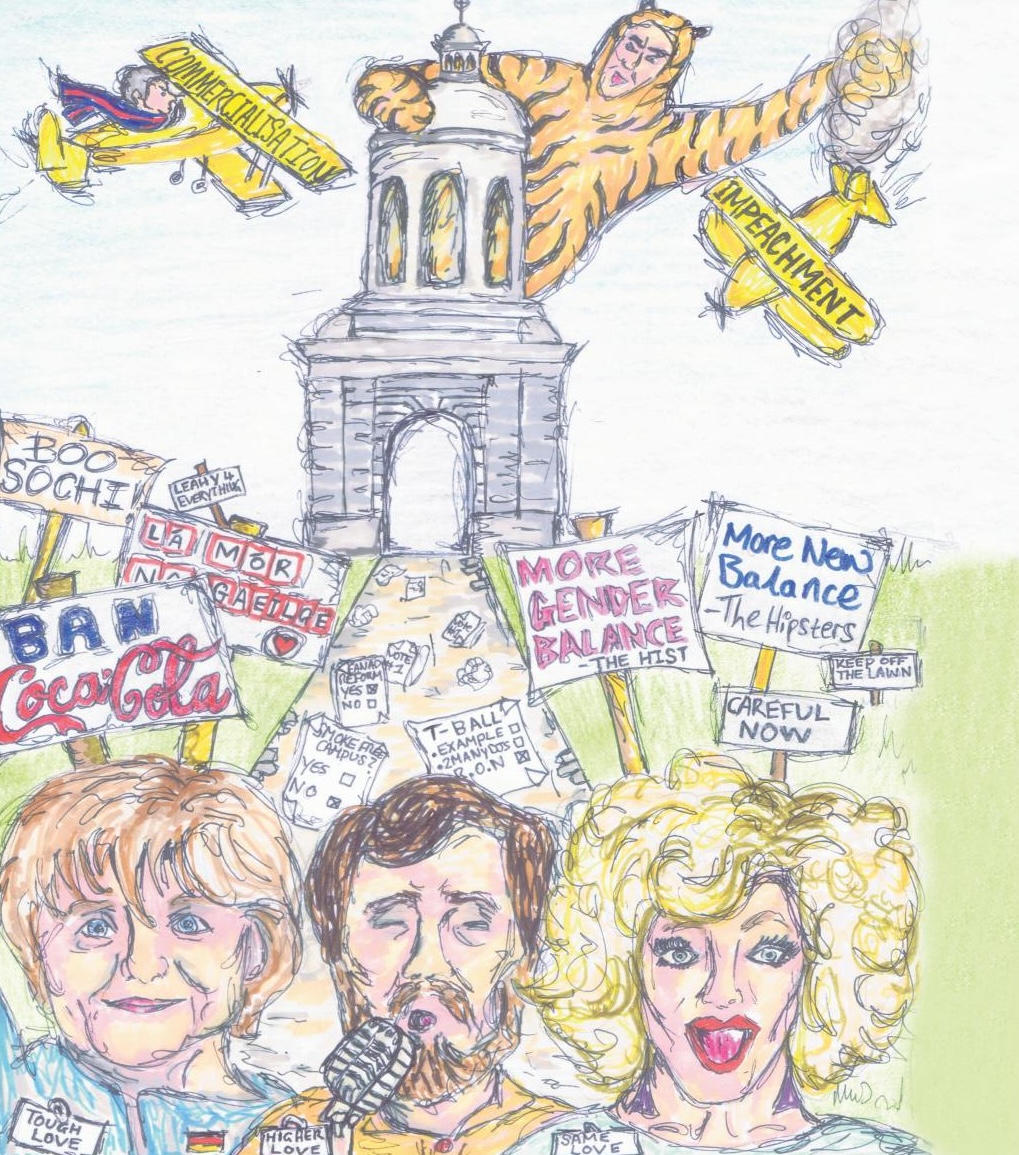

No other company has had as much attention in the history of Trinity College Dublin Students’ Union (TCDSU/AMLCT) politics as Coca-Cola. It has been banned, unbanned, and banned again at Trinity over the past two decades. Its presence on campus has been heavily shaped by student politics at the time — first over the treatment of Colombian trade unionists working for the corporation, later over Russia’s anti-LGBTQ+ laws during the Winter Olympics and most recently, over the company’s operations in illegal Israeli settlements.
Earlier this month, Coca-Cola products were removed from every SU shop and café on campus. The familiar red-branded fridges were emptied — no Coke, Fanta, Sprite or Riverrock. This disappearance is the latest development in a campaign that has been running, on and off, since 2004.
The campaign against Coca-Cola at college began in July 2003, when the Colombian union SINALTRAINAL called for an international boycott of Coca-Cola, accusing the company’s bottling plants of complicity in a violent anti-union campaign. The Colombian union alleged that many of its members had been killed, with others threatened. Coca-Cola denied these allegations, but the campaign nevertheless spread internationally. UCD was the first university worldwide to join the boycott, with Trinity following within months. In 2004, Trinity students officially voted to remove Coca-Cola products from Students’ Union shops. 1800 students voted in favour, with 1600 against. The boycott was led by the Trinity Boycott Coke Campaign and attracted support from trade unions and student organisations beyond Trinity. In Ireland, the campaign received backing from organisations including the Teachers Union of Ireland, the Irish National Teachers’ Organisation and the Union of Students in Ireland (now Aontas na Mac Léinn in Éirinn, or AMLÉ).

Following the 2005 referendum, the ban was upheld. Then, in 2009, the boycott was overturned in another campus referendum, allowing Coca-Cola products to return to Students’ Union outlets. The student referendum did not permanently settle the Coca-Cola on campus question, with the debate resurfacing in 2014, when the SU proposed another temporary ban tied to a different controversy altogether. The campaign was connected to the Winter Olympics in Sochi, where Coca-Cola was one of the event’s major sponsors. During the Games, the Russian government had faced international criticism over legislation restricting LGBTQ+ rights. TCDSU/AMLCT Council (now Comhairle) voted to pull both Coca-Cola and another sponsor, Procter & Gamble, for the duration of the Games. This was explicitly temporary — a two-week ban — rather than a reinstatement of the 2004 ban.
In 2016, the future of any Coca-Cola boycott shifted entirely. Trinity signed a ten-year exclusive deal with Coca-Cola, covering SU shops, as well as other campus outlets including the Buttery, the Dining Hall, the Perch and the Pav. Under the Pouring Rights Contract, campus outlets were generally restricted to selling bottled drinks produced by Coca-Cola. So in 2018, when students overwhelmingly voted in a Boycott, Divestment and Sanctions (BDS) referendum naming Coca-Cola specifically over its operations in illegal Israeli settlements, the vote could not materialise. The referendum received 1287 votes in favour, representing 64.5% of the 2050 votes cast. As boycotting the Israeli State is classified as a long-term policy, the TCDSU/AMLCT Constitution required at least 60% of students to vote in favour. However, a referendum could not override a commercial agreement, so student democracy was not capable of making a change the College itself had not agreed to at the time. The referendum could direct student politics and shape what the Students’ Union wanted to sell, but could not undo a commercial contract that the University itself had signed. Coca-Cola stayed stocked across campus. The referendum became mere proof of what students wanted, with no mechanism to deliver the results.
This position changed in May 2024, when a student encampment pushed Trinity to commit to divesting from Israeli companies, dropping Israeli suppliers, and avoiding new academic agreements with Israeli institutions — commitments that Trinity BDS still regards as incomplete, with the university’s Dual BA programme with Columbia University ongoing. This September, TCDSU/AMLCT finally secured an exemption from the College’s Coca-Cola exclusivity and Pouring Rights agreement. The Union’s own shops and café can finally stop selling the products, replacing the drinks with Lucozade, Palestine Cola, and other products under a supply deal that carries no exclusivity clause. The exemption covers the Union’s own outlets, while the wider College-run spaces remain bound by the terms of the 2016 contract for as long as it runs. Ultimately, the cans have left all TCDSU/AMLCT spaces.
Coca-Cola is not the only company to have occupied this space. Trinity has a much longer history of student boycotts, including the Students’ Union’s boycott of Nestlé, which dates back to the 1990s and centres on concerns over the company’s marketing of infant formula. Boycotts have become one of the ways student politics makes itself clearly visible. The campaign against Coca-Cola has long been at the core of student politics, but as the company’s presence on campus became tied to a college-wide contract, the question was no longer whether students wanted to boycott the corporation, but who had the authority to make that happen.
The removal and return of the cans are at the surface of a larger question surrounding the trade-off between student politics and institutional authority. International political causes have repeatedly been brought onto campus through the products students encounter every day, and the question always comes back to: why Coca-Cola? Ultimately, the position of the Union is largely centred on and confined to campus, whilst many of the issues that motivate student campaigns are very international in scope.
A Union can not directly alter Russian or Colombian legislation. However, it can attempt to control what is sold in its own shops. A large company like Coca-Cola operates globally, meaning that its commercial presence on campus can become a way for students to respond to issues that would otherwise seem far from Trinity. Coca-Cola’s operations in Israel have made it a recurring target of the BDS movement internationally. So refusing to stock its products lets the movement for Palestine occupy a wider space on campus and is a very visible act of solidarity. Ultimately, this gives multinational corporations a particular significance within student activism. Their global operations connect an organisation on campus to widespread political and social issues, while their physical presence on campus provides a practical point for students to act.
The Coca-Cola question has been building up for the past 20 years, and the answer continues to change. One Junior Sophister student, speaking to the University Times, described this move as a “larger change comes as a result of many small steps, and the Student Union’s decision has both symbolic and practical value. Given Coca-Cola’s continued operation in illegal settlements, this action is a welcome step.”
Head of the Arab Society, Yasmin Rasheed, said, “The removal of Coca-Cola from our SU shops is a very welcome act of Palestinian solidarity, and something that I am grateful to see happen on campus. However, we must acknowledge that this is long overdue, and comes almost three years after the beginning of an organised international boycott campaign of Coca-Cola. It also must be acknowledged that there are still products sold in our SU shops that are on the boycott list, such as Cadbury’s chocolate, Evian water, and more. I hope to see the removal of Coca-Cola inspire further boycotting of Zionist companies that do not deserve our business, including the businesses on our doorstep such as Joe & The Juice, Costa, Starbucks, and M&S. If you support Palestine, you should not be purchasing from these places. It is that simple. We live in an unfortunate reality where our money carries greater weight than our words, and as such, when our protests don’t give us results, we need to ‘vote with our dollar’ and cut financial support from zionist groups. Removing Coca-Cola from the SU shops is a great step, but hopefully it is merely one step of many more.”
Generally, wider student sentiment appears to support the recent move by the SU. However, student politics are constantly moving back and forth, and there is very rarely one linear path. Coca-Cola has long been at the centre of student activism in Trinity, but as we have seen, it often circles back, reverses, and loses momentum once held. The Coca-Cola question has been paused and resumed under different names and circumstances over the past two decades, but has never truly been settled. But for now, the red cans are gone, as well as every other can under the Coca-Cola franchise. The exemption clause is broken — but notably only by the SU itself. It is one of the clearest changes we have seen in the SU since Trinity signed the Pouring Rights contract with Coca-Cola. However, the SU’s exemption will not end Coca-Cola’s wider contractual relationship with the College itself, so what happens beyond the Union itself remains unresolved, and so far, there is little sign of an answer from the College.