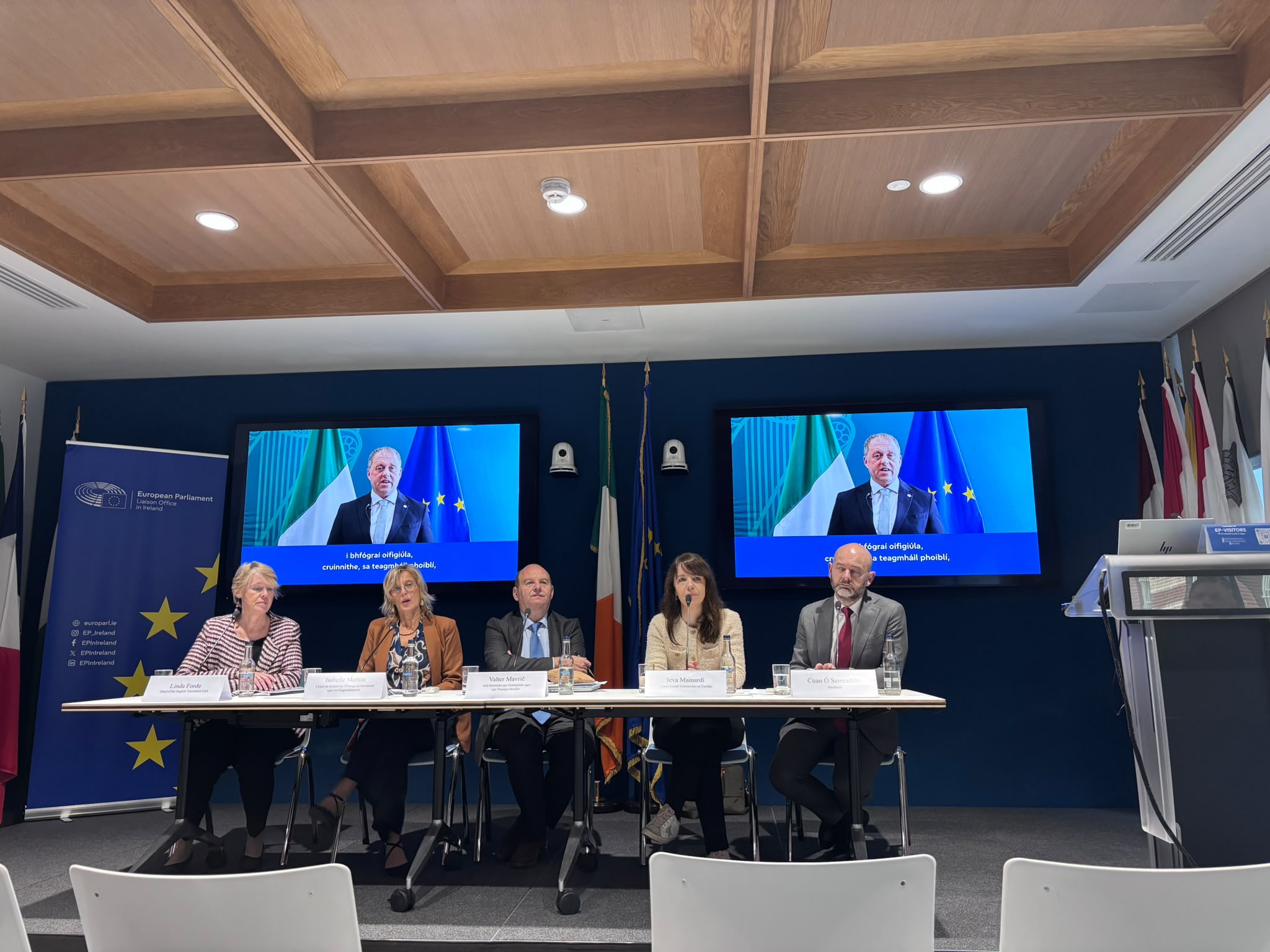

At the European Parliament Liaison Office (EPLO) in Dublin on October 13th, the message to students was loud and clear: the EU institutions need Irish people, and they need them now.
The event, hosted by the Parliament’s Directorate-General for Translation and Clear Language (DG TRAD), brought senior figures from its translation services to Europe House to talk careers. Held at Europe House, the day opened with a panel discussion on multilingualism, English and Irish career and traineeship opportunities, the skills required and the Irish presidency. I also had the opportunity to sit down for a one-on-one interview with Valter Mavrič, Director-General of DG TRAD, after the panel.
A “Career for EU”

The event was introduced by a virtual address from Thomas Byrne, Minister of State for European Affairs and Defence. Minister Byrne used his address to promote the Government’s “A Career for EU” strategy, which offers dedicated support to Irish people seeking jobs in the EU institutions. For more than fifty years, he said, Irish people have played an important role in the European project, and “now is the time for a new generation.”
His pitch rested on two developments. Since Brexit, Ireland has the largest number of native English speakers of any EU member state, and since January 2022, Irish has been a fully official and working language of the EU, on an equal footing with the other 23. Together, he argued, these have created countless new opportunities for Irish nationals.
The timing is notable as this is the first time Ireland has held the presidency of the Council of the EU since Irish became a fully operational working language. So whether your interests lie in languages, communications, law, technology or public policy, he said, Europe needs a new generation of Irish people to help shape its future.
Why not just use one language?
It’s the obvious question, and the panel, moderated by RTÉ Raidió na Gaeltachta political correspondent Cuan Ó Seireadáin, started with it. Wouldn’t using a single working language be cheaper and more efficient?
Mavrič gave two answers. The first is legal. Most EU laws are translated, and they take immediate effect in the member states, so a French-language text, for instance, must be understood universally if Ireland is to implement it properly. The second is communication. Most source texts are written in English, and without translation, a lot would be left open to interpretation.
Isabelle Marton, Head of the Citizens’ Language and Editing Unit, noted that the work is inherently political: texts come out of long negotiations, disputes over wording are common, and translators often suggest edits to authors, Members of European Parliament (MEPs) included. She noted that French and English are the main source languages within the EU institutions. Linda Forde, Head of the English Translation Unit, described her department as a small, active unit working to extremely short deadlines, and said recruitment has been its biggest challenge since Brexit. Mavrič added that colleagues who joined before Brexit are now approaching retirement. English speakers, he stressed, are as sought after as Irish speakers.
Ieva Mainardi, Head of the Irish Translation Unit, added that accurate translation is hard to come by and depends on understanding culture, not solely grammar and vocabulary. She also said the presidency has increased the use of Irish among MEPs and officials immensely, so the need for native speakers is ever more urgent.
What about AI?
For students like myself wondering whether a languages degree still leads anywhere, the panel was reassuring. Mavrič said AI is a tool that is still in a test phase and is not yet in official use at the Parliament, while Marton said careers in languages are not under threat, because AI cannot replace human judgement. Forde added that legal, confidential and harassment-related files require human discretion and empathy.
Speaking to me after the panel, Mavrič described what is changing. The new skill, he said, is post-editing, so essentially reviewing what the technology produces. Some people dislike what he called the “red pen syndrome” familiar from primary school, but he enjoys it. Sometimes, he added, it is quicker to translate from scratch than to fix a flawed machine draft. And with EU law, the stakes are high. “The law is a law,” he said, with legal consequences, and nobody wants an artificial tool writing it.
Minister Byrne made a similar point in his address when mentioning technology. He said it raises the value of people who can exercise judgement, spot nuance and write clearly. Alongside linguistic excellence, he listed digital skills, critical thinking and strong editing.
How do you get in?
For recent graduates, the traineeship scheme is the most direct way in. The Parliament takes on trainees across two five-month intakes, in October and March, with a quota of places for non-EU nationals reserved for candidate countries.
Mavrič, who oversees the world’s largest parliamentary translation service, joined in 2004 as head of the Slovenian Translation Unit and has led the service since 2014 (as Director-General since 2016). He knows what starting out looks like: when he built that unit as Slovenia joined the EU, many of his recruits were beginners, and he had to teach them not just languages but how to translate.
Asked what he would like to see for Irish after the presidency passes to Lithuania, he said translation coverage is almost complete and will continue, and grow, afterwards. For English, his concern was different: many drafters write in English without it being their mother tongue, so the Parliament needs editors and translators to make texts clearer before they are translated.
The message of the event was made clear throughout. The EU needs English speakers and Irish speakers, and it needs people who can think, not just translate. As Minister Byrne put it, Europe needs your talent.