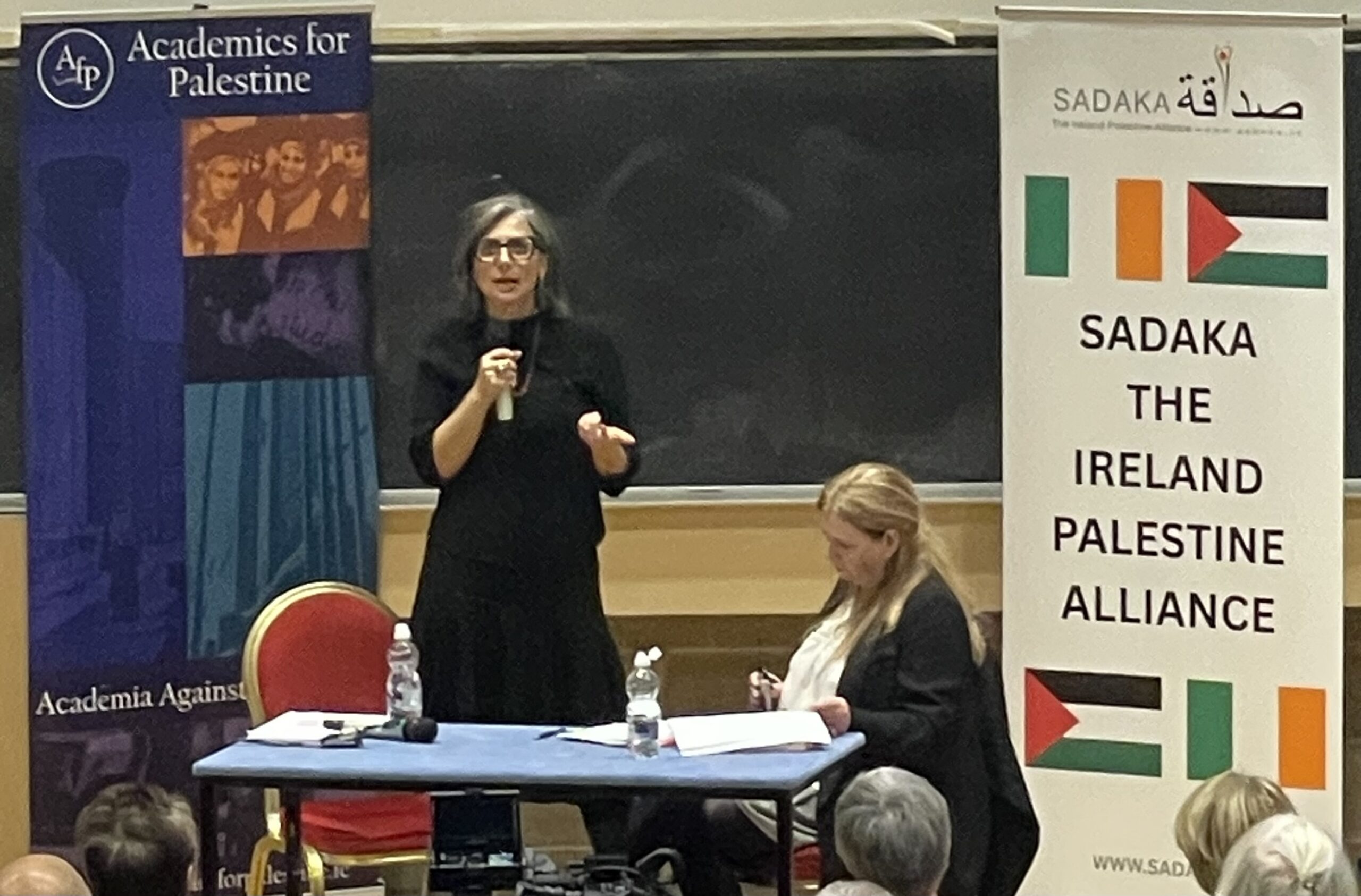

On Wednesday evening, Francesca Albanese spoke to a crowded Edmund Burke theatre to discuss her role as the United Nations Special Rapporteur on the occupied Palestinian territories, and the work she has conducted uncovering the actions of Israel against the Palestinian people. She began her speech by highlighting how the situation in Gaza has deteriorated in the three and a half years since she last spoke in Ireland, accusing Israel of having turned the region into a “wasteland”. She noted that 74,000 Palestinians have been killed since the war began, 21,000 of those being children. She also highlighted the 300 journalists that have died as a result of the conflict, the highest number of journalists killed in any war in recorded history.
Albanese particularly criticised the EU for maintaining its trade links with Israel, and observed that Ireland was its biggest trading partner within the bloc (notable, she queried, considering the Irish government’s current push to suspend preferential trade with Israel). She continued by emphasising how Israel has “capsized” the function of international law, using measures such as evacuation orders and safe zones as “humanitarian camouflage”, and noted that Western media was complicit by parroting the Israeli government’s rhetoric. She urged the Irish people to make their solidarity “intelligent”, and underlined the importance of educating others on the issue. Albanese described next week’s meeting of European heads of state in Dublin as a test, and told the audience they must ask themselves what they want their government to say. The Rapporteur concluded her talk with a quote by Edmund Burke himself, characterising Ireland as possessing an “interior history” with a voice that differs from colonial authorities.
When asked about her role as the first UN rapporteur to investigate an ongoing genocide, Albanese noted that the past few years have been “brutal”. She noted the suffering that has been endured not only by the Palestinians but also the Iranian and Lebanese people due to the actions of both the Israeli and US governments. She described the impact that her work has had on both herself and her family, referencing the impact of US sanctions placed on her which have prevented her from opening a bank account even in the EU (reflecting, she argued, the EU’s position as a “de facto colony” of the US).

On her latest report, focusing on the role of the media with regards to the genocide, Albanese emphasised how Western media downplays the actions of the Israeli state through editorial guidance that specifies, for example, labelling Palestinian children as “young people” to soften reaction to their deaths. She also recounted the story of journalist Antoinette Lattouf, who was fired from Australian state broadcaster ABC for sharing a post by Human Right Watch which accused Israel of using starvation as a tool of war after. She further noted the role of propaganda and censorship conducted by the Israeli government to further their narrative. When asked about what can be done to help (especially considering the current Irish Presidency of the EU), she told the audience to “strive for coherence”. Referencing the recent electoral success of the Student Movement in Serbia, she told the theatre that “principled people” must shape the course of history. In other words, it was “over to you, Irish people”.
During the talk, members of the audience held signs demanding the GAA cut ties with Allianz, as Palestinian groups argue the insurance company is the biggest purchaser of Israeli war bonds in the world. The event itself was organised and hosted by Sadaka, an Irish NGO focused on advocacy on behalf of the Palestinian people. The talk was organised to coincide with the mid-term of the Irish Presidency of the EU.