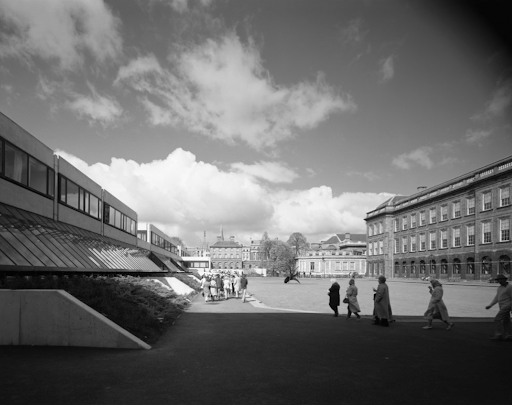

A mystical tradition in Hasidic Judaism refers to 36 righteous people in each generation who safeguard the world and sustain humanity from divine wrath. They are neither priests nor prophets, but live as humble artisans and labourers. Three such people, perhaps, were born in a single year: 1933. Their names were Ahrends, Burton and Koralek. They founded the eponymous architectural firm ABK, and led the construction of the Arts Building (or Arts Block) and drew up the prize-winning design for the Berkeley (now Boland) Library.
The Arts Block, however, is hated. Tourists hate the Arts Block for its incongruity. Maximalists hate the Arts Block for its simplicity. Elitists hate its accessibility and flâneurs hate its utility. The Arts Building shocks the Fresher with its brutality and scandalises the Fellow’s sentimentality. Just about the only group that does not hate it — or at least, shouldn’t hate it — is the body of students who, day in and day out, take notes, study and socialise throughout its austere lecture theatres and bare halls.
The Arts Building is the largest on campus, but you would hardly notice that fact amid its ostentatious rivals. When I have asked people what they believe Trinity’s largest building is, answers I’ve heard have included the labyrinthine Trinity Biological Sciences Institute (TBSI), the oppressive Goldsmith Hall or the flashy Business Building. No one suspects it is the Arts Building, even if they’re humanities students.

Part of this is due to the terrace structure, such that from the outside the upper floors of the complex retreat from the viewer’s eye. I believe another reason, however, is that the facility of navigating the Arts Block makes it feel smaller.
The Arts Block has the highest foot traffic from students of any building on campus. That initially surprised me: I have waited for what felt like minutes to escape Goldsmith Hall, through its set of double doors at the front, following a packed Intro to Econ lecture. I have gotten lost navigating the TBSI underground and searching for meeting rooms in the Business Building. With three large entrances/exits, on the other hand, the Arts Block is astonishingly easy to enter or leave given the sheer amount of students who rush to and from its concrete rooms.
With three stairwells and an elevator, the Arts Block also makes traversing easy. Even as the hour-mark approaches and Classics students hike up to their lecture on the sixth floor, the distribution of access-points to any given room diffuses the crowdedness of pupils scrambling for a lecture — a frequent sight, for instance, at the stairway to the bedecked interior of Regent’s House.
The Arts Building also offers functionality. This, of course, is the place for your lectures and tutorials. It is also for society movie nights and political meetings. The much-used and much-abused noticeboards contain just about every event worth attending and every saint and sinner’s bid for the limelight. The Perch gives you the caffeine-kick before a long session in the Lecky library, the entrance to which is mere metres away.
The location enhances this feature. The Arts Block looks over the green grass of Fellows’ Square, dotted with seagulls, shadowed by a looming crab apple tree and covered, on sunnier days, with students perusing novels or lounging with their friends. The exit at Nassau Street opens up to several cafés, brunch spots and bookstores close enough for making a purchase in the 10-minute break between lectures. The tables on the sixth floor provide a beautiful view of the historic Morrison Chambers building (now the home of Costa Coffee). Still dissatisfied? The oft-missed fifth-floor rooftop garden is a great place to catch a moment of peace and quiet or to take a smoke break if the Arts Block entrance is not your thing. With numerous bathrooms, water bottle refillers and tables, and a bottle-return machine to boot, the Arts Block has everything one needs for life within a one-minute radius.
But this is, a critic may allege, absolutely outrageous! Am I suggesting that the Arts Building outshines the marvellous Georgian exterior of Front Gate? Or the marvellous, Venice-inspired Museum Building, with its individually carved stone floral designs?
Absolutely! Not in isolation—for no building exists in isolation, as if it could be separated from the walkways, promenades, and institutions which surround it (in short, the lived life of its many visitors) — but absolutely the Arts Block triumphs over these, admittedly impressive, works of architecture.
Take the Museum Building: the palazzo style, from the heyday of John Ruskin’s artistic criticism, is a welcome change of scene within Dublin’s awfully one-note architectural trends. Nevertheless, it is awkwardly situated in relation to the library and residences, often requiring ambling through a small depression in the ground to get to its wooden door. On the inside, the marbles are bedazzling at first, but the echoey acoustics (pray you don’t have a class in the drawing room) and confusing layout demonstrate that it is a building for vacationers first, students and staff second.
Furthermore, I have nothing against the neoclassicism which dominates around Front Square. But does this really distinguish Trinity? There is not a single major city in Europe where the lover of Greco-Roman antiquity cannot find a suitable abode. Nor, in truth, are there many neighbourhoods of Dublin which are lacking in at least a Palladian flair. The emphasis on façades over free movement has taken its toll: the narrow entrance of Front Square has frustrated not a few students who frantically push past leagues of aloof tourists.
In short, the Arts Building is ergonomic and economic, austere and authentic; it does not impose upon students and staff, nor does it imprison them. The abstract art on its walls and the varied outfits in its halls stand out marvellously against its concrete interior. A little time at Trinity inclines one’s heart against the Arts Block; a lot of time at Trinity brings one’s heart back to it again.