
Nearly 2,000 vessels are stranded on both sides of the Strait of Hormuz, their engines idling, their cargo going nowhere. Oil tankers, liquified natural gas carriers, fertiliser ships – the circulatory system of a globalised world, brought to a standstill by one of the oldest instruments of warfare: the blockade. The war in Iran, now entering its second month, has produced no shortage of grim statistics. But it is this image – an armada of commerce frozen in place – that most precisely captures what is at stake, and why the world’s response has been so fractured and so inadequate.
This war is a rupture in the international legal order. The rules governing both military conduct and freedom of navigation are being violated by multiple parties simultaneously, and the institutions meant to enforce them have proved largely powerless. The question is no longer whether this war will reshape global politics – it already has. The question is what, if anything, remains of the framework that was supposed to prevent it.
To understand how we arrived here, one must trace the escalation that neither side managed to arrest. Israeli and US military strikes in 2024 and over twelve days in 2025 had already undermined Iran’s defences and nuclear programme, while many of Iran’s regional allies had been significantly weakened, primarily through Israeli military action. By early 2026, Iran was internally fractured as well as externally diminished – extensive protests, driven by a weakened economy and struggling infrastructure, illustrated the regime’s eroding legitimacy. When three rounds of indirect nuclear talks in Geneva collapsed in February – despite the Omani foreign minister stating significant progress had been made – the window for diplomacy closed. On 28 February 2026, US and Israeli forces launched coordinated strikes, dubbed “Epic Fury” by the Pentagon and “Roaring Lion” by Israel, killing Supreme Leader Ali Khamenei, whose death was subsequently confirmed by Iranian state media.

The human cost has been severe and contested. Iran’s Health Ministry reported that, as of day 28, at least 1,937 people had been killed by US-Israeli strikes, with over 24,800 injured, including 1,621 children. The Washington Post independently reported nearly 1,500 Iranian civilian deaths. UN Secretary-General António Guterres condemned both the US-Israeli strikes and Iran’s retaliatory attacks, warning of “a grave threat to international peace and security” and calling on all parties to protect civilians and respect international law. Iran has invoked the right to self-defence under the UN Charter. Whether that self-defence claim is legally credible is disputed; what is not disputed is that civilians on multiple sides are paying the price.
Iran has responded militarily, and the conflict has since spread across at least a dozen countries, with over 2,300 people killed across the wider region. Gulf states housing American forces – Bahrain, Saudi Arabia, Kuwait, Qatar, and the UAE – have sustained waves of Iranian missile and drone strikes, with Iranian missiles targeting the headquarters of the US Navy’s 5th Fleet in Bahrain multiple times. Thus far, the US military has confirmed 13 fatalities. The Atlantic Council notes that Iran perceives itself to be in an existential conflict, calculating that a slow, protracted war of attrition is its most viable strategy – banking on its greater willingness to absorb pain than either the United States or Gulf countries.
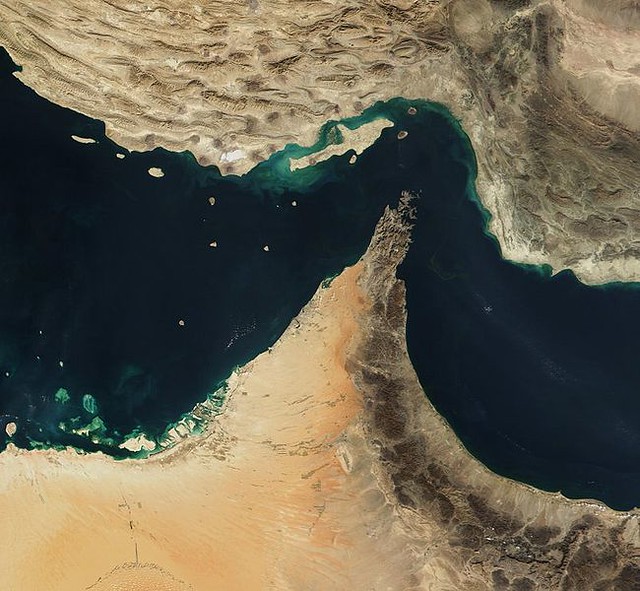
It is in the Strait of Hormuz, however, that Iran has found its most devastating weapon. Roughly 27% of the world’s maritime trade in crude oil and petroleum products ordinarily passes through the strait. Iran has shut it down, leading to consequences that have been immediate and severe. Energy companies, including Qatar Energy, Shell, Kuwait Petroleum Corporation, and Bapco, invoked force majeure – unprecedented in the history of Gulf oil and gas production. Iraq was forced to cut oil production in the Basra region by 70%, from 3.3 million barrels per day to 900,000. Oil prices surged above $100 per barrel from a pre-war price of around $65 – a rise of more than 40%.
The blockade is not indiscriminate – it is a finely calibrated instrument of coercion. Iran has demanded international recognition of its sovereignty over the Strait of Hormuz as one of its conditions for ending the war, with Iran’s new Supreme Leader stating that the leverage of blocking the waterway must continue to be used. Ships from China, Russia, India, Iraq, and Pakistan have been selectively permitted to pass; Western-aligned vessels have not. At a reported fee of $2 million per tanker, analysts calculate that a full tolling regime could potentially generate Iran over $800 million per month – comparable, in theory, to Egypt’s earnings from the Suez Canal. Iran has not merely closed a waterway. It is attempting to monetise and sovereigntise it.
Whether it can do so legally is another matter. Under Articles 37 through 44 of UNCLOS, all ships have a right of transit passage through international straits “which shall not be impeded,” with no suspension permitted – the logic being that when global trade depends on a narrow corridor, bordering states are not allowed to use it as leverage. Scholars writing in Just Security have been blunt: Iran’s attacks on neutral shipping and potential mining of the strait violate both the law of the sea and the law of armed conflict, revealing a fundamental weakness – transit passage is strongly protected in doctrine but difficult to enforce when a coastal state is willing to break the rules. The strait has become a live test of whether international law means anything when a state has the physical capacity to defy it. Thus far, the law is losing.
The United States has responded with characteristic volume and variable success. On March 15th, President Trump called on countries receiving oil through the strait to “take care of that passage” militarily. The request was refused with remarkable unanimity – Germany, Spain, Italy, the UK, Australia, South Korea, and Japan all declined – with German Defence Minister Boris Pistorius stating: “This is not our war, we have not started it.” The rebuff reveals something deeper than strategic calculation. Richard Haas, former Special Envoy for Northern Ireland, posits that allied reluctance stems not only from doubts about the mission itself but from broader unhappiness with Trump administration policies – above all, tariffs and the withdrawal of support for Ukraine. Allies subjected to economic pressure and diplomatic condescension are disinclined to share military risk in a war they were not consulted about.
Some ground has since been recovered diplomatically. A coalition of six countries – the UK, France, Germany, Italy, the Netherlands and Japan – signed a joint statement condemning Iran’s closure of the strait and expressing readiness to ensure safe passage, later growing to over 35 signatories. But Italy’s Defence Minister said the declaration should not be seen as a “war mission,” and Germany said any military involvement would require a ceasefire and parliamentary approval. A statement is not a fleet.
Neutral states bear the devastating humanitarian and economic consequences of a conflict they did not choose, while existing legal frameworks offer them neither adequate protection nor any meaningful remedy. That is the quiet scandal at the heart of this war – that its most acute costs are being borne by nations with no hand in starting it: from the stranded seafarers of the Indo-Pacific to the food-importing populations facing fertiliser shortages they cannot afford. The Strait of Hormuz has always been the world’s most critical maritime corridor. What 2026 has revealed is that the rules meant to keep it open are only as strong as the political will to enforce them – and right now, that will is running dangerously low.