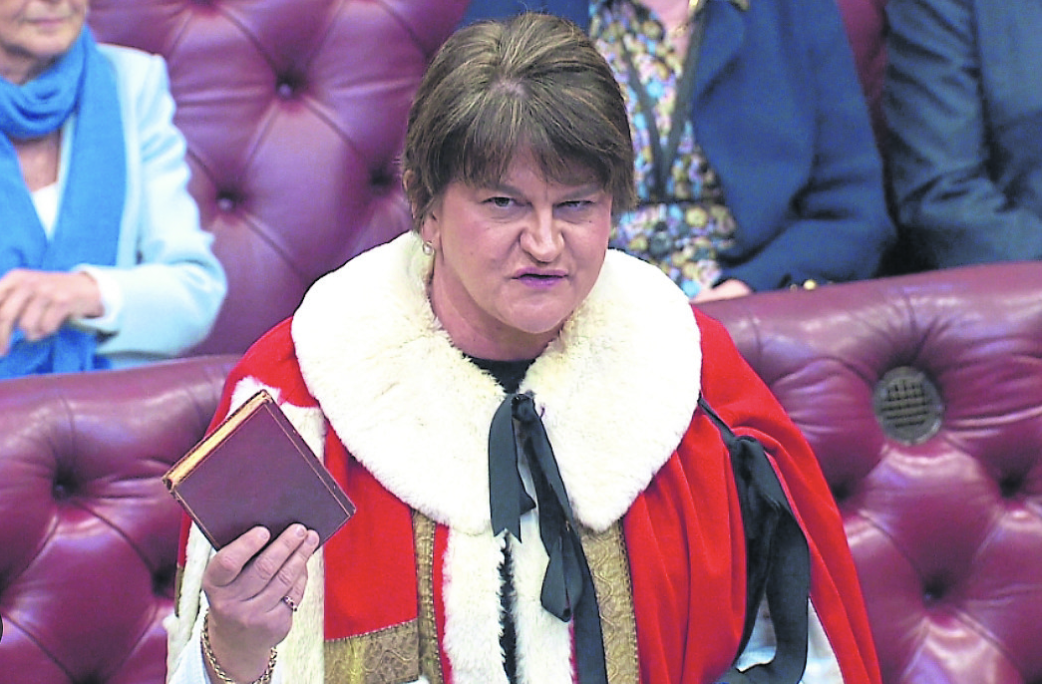

In the United Kingdom, House of Lords Peers have voted to approve an amendment to the Crime and Policing Bill, currently in the concluding stages of passage before receiving Royal Assent in Parliament, which would make the phrase “Up the Ra” a criminal offence. The motion was proposed by former Democratic Unionist Party leader Baroness Arlene Foster, who framed the move as an attempt “to reduce any harmful normalisation of terrorism”.
The proposed revision has garnered media headlines across the United Kingdom and Ireland, elevating the amendment beyond a matter of semantics to a debate surrounding the regulation of free speech and the uneven application of standards across the political spectrum. Rather than existing in a vacuum, it comes against a backdrop of parallel flashpoints in Anglo-Irish relations. The potential for legal challenge is redolent of the recent court battle between Liam Óg Ó hAnnaidh, member of Belfast-based rap trio Kneecap, and the Crown Prosecution Service, after the former was charged under the Terrorism Act 2006 after allegedly displaying a Hezbollah flag during a concert, raising questions surrounding the boundaries between political expression and terrorist inclinations.
The amendment seeks to remove the “emulation requirement” from the “glorification of terrorism” offence. Proponents in the House have cited the burden upon prosecutors to prove a person not only praised a proscribed organisation but encouraged others to carry out terrorist acts or offences as “a very high bar to meet for prosecution”. Foster raised a St Patrick’s Day parade in Newry where “parents were buying balaclavas and scarves with IRA slogans on them for their young children” as the smoking gun for the linkage between the ‘glorification of terrorism’ and republican slogans.

Foster’s proposition drew some, though not widespread, support across the Lords as Peers issued 213 “ayes” to 188 “noes”. Dennis Rogan, leader of the Ulster Unionist Party in the House, made clear the association between the so-called “Ra” and “the most hideous terrorist group” of “Sinn Féin/IRA”, telling colleagues he witnessed youths on the London Underground chanting the controversial phrase. He conceded that “I do not think those young people fully realise the hurt and offence that [it] gives to the victims”. Therein lies the issue. The subjectivity of the clause surely calls for a common-sense approach, which risks asymmetrical enforcement. Claire Fox, Baroness of Buckley, established the difficulty of discerning between chants and songs carrying political or cultural resonance at, say, a football match, and what she perceives as genuine threats in radicalised individuals at university campuses.
Accompanying legislative scrutiny surrounding the logistics of implementation are mixed reactions, which reflect underlying and perhaps not yet fully dissipated societal tensions. Oppositional commentators have expressed incredulity, asserting that applying the amendment selectively to one slogan sets a precedent for restricting freedom of speech. They view the action in tandem with a lengthy and difficult struggle between the British state and Irish nationalism, reminiscent of not only conflict over territory and sovereignty, but also language and legitimacy. One critic condemned “how far the neighbours are drifting away” from republican sentiment, whilst another viewed the debate as triggering a point of contention which many have worked hard to bury. Foster pre-emptively refuted such accusations in the House, asserting “this is not about the past; this is about the future”.
Though the measure has passed in the Lords, it is not yet solidified as law. Lord Hanson of Flint, a minister in the Home Office, signalled reluctance to “accept the amendments in the current form”, an indication of the troubled waters ahead when the Crime and Policing Bill returns to the House of Commons for further consideration. Input from civil liberties groups and legal experts can also be anticipated in the primary legislative chamber of Parliament. Whether they will accept, amend, or reject the alteration is yet to be determined. What is certain is that it will neither pass nor fall without contention, which is likely to focus on competing demands of public safety, legal standardisation, and the legacy of conflict.