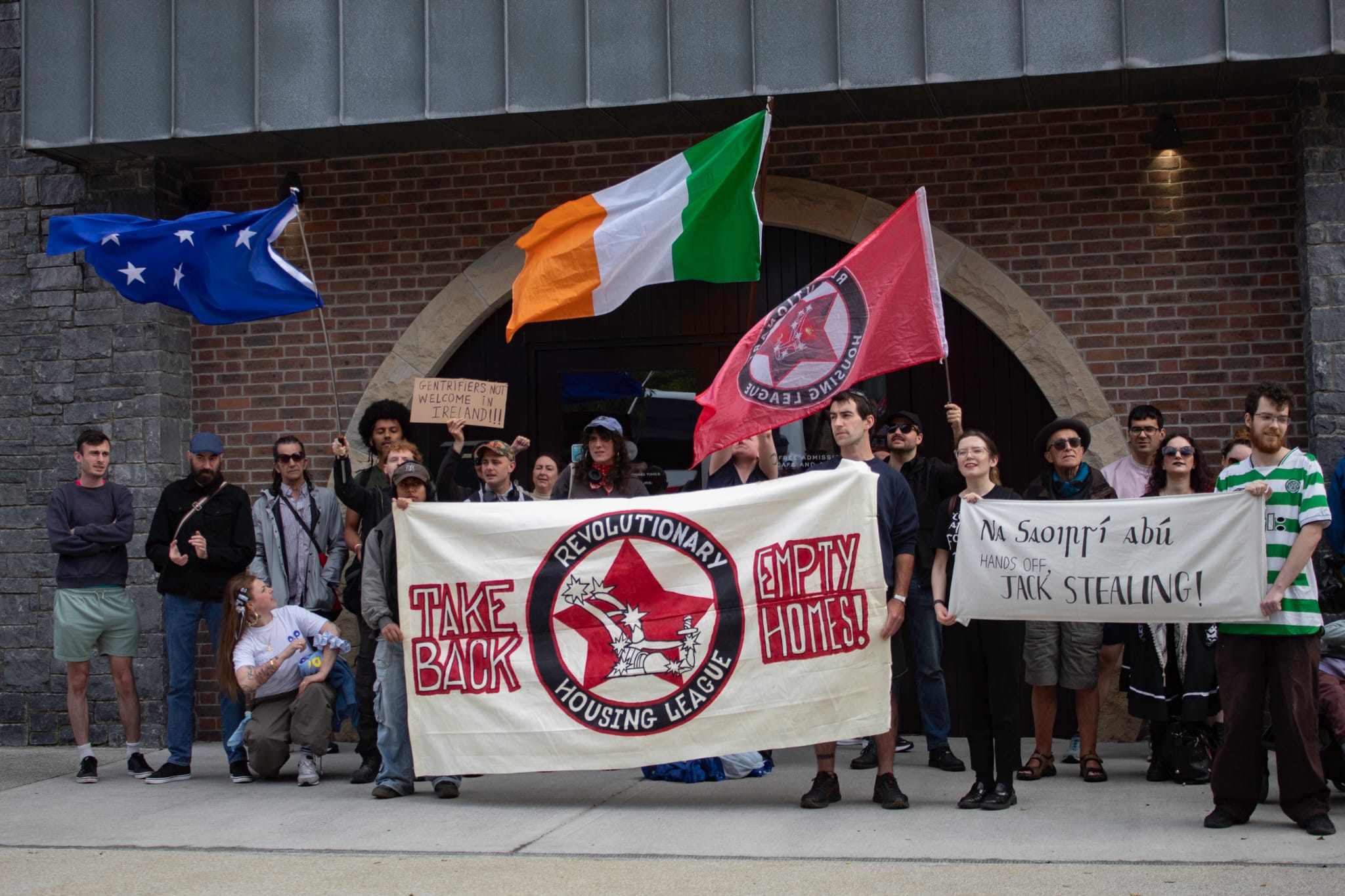

The Liberties is, undoubtedly, one of Dublin’s most vibrant and historic areas. Home to St Patrick’s Cathedral, the Liberties Market, and the Guinness Storehouse, the Liberties plays a key role in Dublin’s cultural fabric, earning itself a mention in Time Out magazine as one of the “Coolest Neighbourhoods in the World”. Although millions of euros are being poured into the construction of hotels and private housing every year, little has been done to support the working-class communities who make up the heart of the Liberties. For residents, it has become clear that Dublin does not wish to ignore the area itself, but the people who inhabit it.
Despite calls for communal amenities such as public bathrooms and water fountains, large sections of the Liberties remain without such facilities. According to Ciara O’Rourke, a member of the local community, there has been a long-felt “sense of disappointment” for working-class residents. “We’ve been let down for decades. People are at the end of their tethers. They recognise that it’s state-structured decisions that are doing this…and working-class people have been living with those decisions for a very, very long time now. If they wanted to provide amenities, if they wanted to provide housing, they could. The only interest they have is for the developers.”
The Anne Devlin Community Centre, run by the Revolutionary Housing League, served as a response to the refusal to invest properly in the communal spaces of the Liberties. The Centre opened the doors of Ardee House (a former pub that had sat unused since 2010) to the public in May in an attempt to answer the needs of the community. In a caption on their Instagram page describing the first of their weekly Monday events, the Centre said: “This community, in the heart of Dublin City, has been crying out for community space, as the landlords, capitalists and financiers continue to gentrify the area and push people out of their homes.”

Fernóc O’Cuilleáin, a representative of the Revolutionary Housing League, described the motivation behind the Anne Devlin Community Centre’s establishment as a natural expansion of their involvement with housing in the Liberties. “Everyone has some form of experience with housing, but that kind of expands out into what is actually public space, what is space that we can take up as a people and own collectively. So the Community Centre was set up to offer essential services to local people, but also as a physical space for people to meet and discuss wider issues like accommodation, rent hikes, cost of living….and then how we can build on that and turn it into actual effective action.”
The Community Centre was a hub of activity during the day, hosting a range of events, from darts to clothes swaps to Irish language classes, and quickly caught the attention of the local community. O’Rourke explained how she first started seeing advertisements for the Anne Devlin Community Centre. “I had noticed a couple of posters around… so I went around with my son then for a scheduled activity. They were doing weaving, and we played darts as well, which was great. That was a kids-based thing. There was boxing…there was all sorts of activities.”
For O’Rourke, the Centre served not only as a communal hub, but as an essential place for parents to access facilities not provided by Dublin City Council.
“My son is eight. It was a community hub for him as much as it was for me; it gave us both space to do things, whether together or separately….I was able to do art while he was doing another activity, and it was supervised. It was a nice calm space…we would go there most afternoons for at least an hour, and it became a huge part of our routine.”
“They [the activists running the Community Centre] were extremely welcoming to everybody. You know, when I went down there, there was always a mixture of local people…particularly mums and kids….it became something to look forward to. So personally, my experience was excellent. They were very professional and welcoming; they weren’t pushing any sort of agenda. It just seemed like they genuinely wanted to create this desperately needed space that we didn’t have.”
Elayne Harrington (also known as Temper-Mental MissElayneous) is a local artist and creative who organised events at the Centre, such as the Anne Devlin Boxing Club. In her eyes, the space quickly became a space for connection.
“Although our individual circumstances differed, many of us faced similar issues”, she said. “Poor maintenance, inaccessible housing, long waiting lists for transfers, inadequate responses to disability needs, insecure tenancies, and a general lack of accountability from the bodies responsible for providing housing. It became clear that these were not isolated experiences but symptoms of much wider structural problems affecting communities across Dublin.”
For the Revolutionary Housing League, the importance of the Centre was twofold. “There’s two things going on,” said O’Cuilleáin. “You have the central aspect for just putting on things for people…first aid workshops, bike repair workshops…but also with that underlying political message. Somewhere where people can come in and relax, but also engage with politics. Even just chatting to people about how there’s mould in their house, or how they’re struggling to pay a bill….just talking on a human level.”
The Anne Devlin Community Centre was established in Ardee House, a disused building owned by Black Sheep Investments, which has Teeling Whiskey’s Jack Teeling as director. At 9 am on Monday the 7th of July, two activists were arrested by the Gardai, as private security evicted the Revolutionary Housing League from the Community Centre, following weeks of the building being watched. Although the Anne Devlin Two, as they are referred to on social media, were released shortly thereafter, there remains little hope for the reopening of the Anne Devlin Community Centre in Ardee House.
In O’Cuilleáin’s opinion, “the purpose behind wearing away the fabric of communities is so people are divided…and more reliant on the state. It’s the typical tactic of divide and conquer. I think that’s why they were so afraid of us…because we were showing people that they’re actually more powerful as a collective.”
For the children of the area, including O’Rourke’s son, the closing of the Centre came as a significant blow.
“It’s upsetting for him,” O’Rourke explained. “He doesn’t understand why he is so different that he can’t have just basic things at this stage. It’s not even the extras, is it? And that’s how low and trodden we’ve become, that we’re asking for the basics.”
In the eyes of the Revolutionary Housing League, however, the shutdown may be a step back, but it is not the end of the mission of the Anne Devlin Community Centre. “The main drive for us was to show that people shouldn’t be hopeless,” said O’Cuilleáin. “If we can do this with barely any money and a few volunteers, then imagine what we can do if everyone gets together. This kind of project was to show people that they have power…and the fact that people saw that there was such a heavy crackdown opened people’s eyes that we were actually doing something right…If anything, people are fired up and ready to do more.” They finished by assuring that they had always known their time in Ardee House was likely limited, and that the shutdown will not hold them back. “If we get moved out of one place, we’ll just find the next one until we have a proper established community centre.”
Harrington shares a similarly resilient opinion. “I want to be clear: the community itself has not disappeared,” she assured. “The relationships built through the Anne Devlin Community Centre still exist, and the work of the Revolutionary Housing League continues. The acquisition of the building was itself an act of protest—a statement that communities should have a say in what happens to the spaces they live alongside. The building may have closed, but the message remains. Communities need places where people can gather, organise, create, support one another and simply be together. Those spaces are not a luxury; they are essential infrastructure for a healthy, connected community.”
The Anne Devlin Community Centre, and the support it received from the community surrounding it, serves as a reminder to Dublin City Council that the needs of everyday people cannot – and will not – be forever ignored.