
Picture this. It’s 2pm on Friday, September 4th, and you are roaming around town before taking a pitstop into Arnott’s. Just a quick look, surely nothing crazy to see here, you say… Or so you thought!
As you are wading through the cascade of smells from the perfume aisles and heading towards the staircase leading to the bottom floor, you hear a familiar jingle. Are they Christmas bells? In September? It’s not even Halloween yet!
Your suspicions are confirmed as soon as you see the shop and decorations. You aren’t alone in your befuddlement. Pretty much every customer who stumbled across this ridiculously early tinsel-wrapped assault on September has the exact same thoughts, and you laugh it off as a form of commercial comedy routine with a glittering snowflake bauble stuck on the top for good measure. Turns out, it was the first day of the Christmas celebrations at Arnott’s and in hindsight, you really are not surprised at all.

Every year is the same. If you sell Christmas early, you gain an upper hand on your competitors. The basics of supply and demand say that the more supply of a product you have, the lower the price will be. The higher the demand, the higher the price. Businesses portray the Christmas market as “if you shop early, you will get a better deal”, and most consumers feed blindly into that vision. The reality is that the prices are artificially raised to make consumers think that they are paying for a bargain when in fact they are paying no more than the usual price.
But besides the obvious commercial side of it all, has the celebration of Christmas lost its traditional roots that have anchored the celebrations for the last couple of millennia?
The decline in the numbers of those in Ireland who identify as Catholic has been a major trend in the last few decades. In August, RTÉ reported that baptism rates plummeted by 30 per cent in the last decade alone, while the 2022 census showed that there was a 187 per cent increase in those who have no affiliation with any religion compared to 2011. Is the decline in Catholicism directly related to the upwards trends in consumerism and commercialism, especially before and during Christmas? Not completely. Rather, it is a symptom of it. Hint: Celtic Tiger.
The first thing to clarify. I am not religious. I had a troubled and turbulent relationship with religion that started as soon as I entered secondary school. Most of the things, stories and parables that I learned through the Bible suddenly clashed heads with the realities of life. My scientific understanding of the world influenced the ways in which I now viewed the teachings of the Bible. I found it increasingly difficult to approach the readings from a literal point of view, and eventually, I outright rejected their ideas. The physics outmuscled the faith.
Furthermore, the same-sex marriage referendum happened right as I finished my first year in May 2015. Just three years later, almost to the day, the abortion referendum passed. Both of these referendums were deeply emotional and highly contentious. They served as battlegrounds for the redefinition of our cultural and social DNA, and my own identity was no different.
Many others, certainly in my age bracket, will have felt the same. Our values and understandings irreversibly changed. Ireland entered uncharted territory. These cases were a direct and definitive break from the teachings of the Catholic Church. Truly life-changing.
Of course, having family member(s) that vehemently support the Catholic Church whilst you grew increasingly sceptical of their views and way of life was always going to create a crucible of tension and flashpoints, further drawing me away from religion altogether. But, despite the tit-for-tat and the fractious debates throughout the year, Christmas was always a brief but memorable and happy occasion for me. A laying down of arms. A time for comfort. A period of peace.
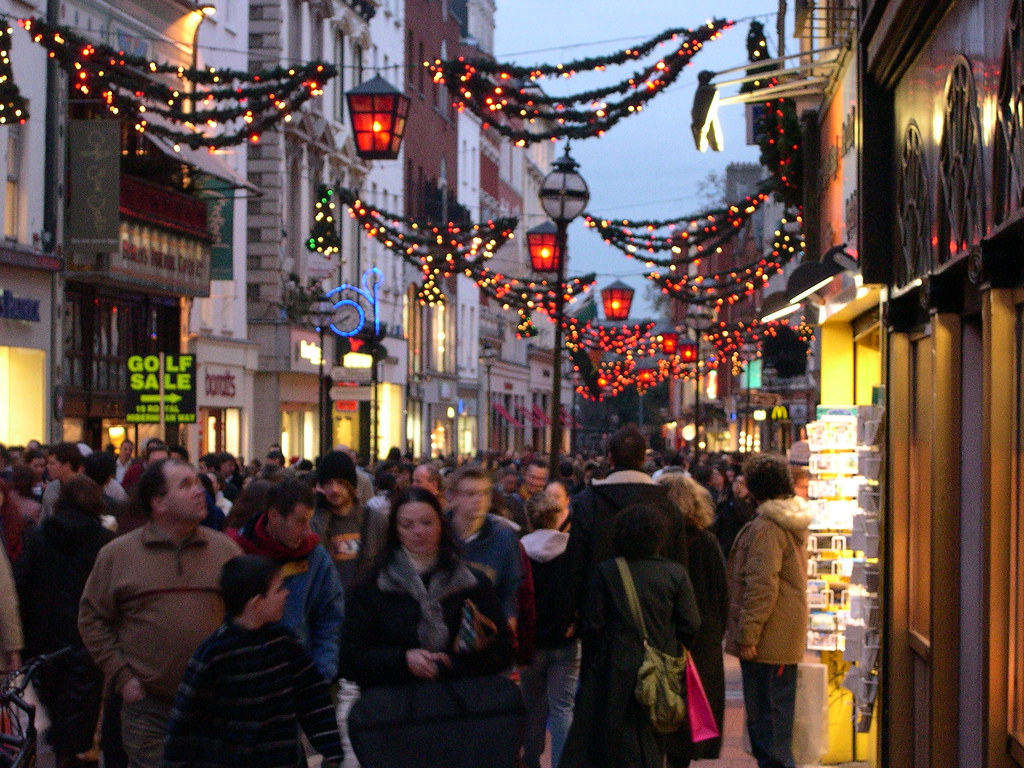
Christmas never was, and never is, about what gifts I received. It is about embracing one another as a family, reflecting on the values of hope and love, and a time for celebration. These are features that align with Christian perspectives. These values that shape the spirit of Christmas have been masked by the caveat of commercialisation, consumption, and corporate greed. You can look no further than your nearest shopping centre for evidence of this. It certainly feels as though the vacuum left behind from the loss of people’s understanding of the meaning of Christmas is being hurriedly filled in by material urgency.
Of course, we cannot underestimate the effect of the Celtic Tiger era from the 1990’s to the 2000’s and how we irreversibly transformed into a global and modernised economy. Between 1987 and 2007, Ireland’s GDP grew by a massive 229 per cent. Suddenly people had money, they didn’t know what to do with it, so they spent it. This fed into the growing consumerism market, driving an expanding wedge between the frugality of the old Christmas traditions and the materialism of the new. The simplicity of the social connections we had with one another during Christmas started to attenuate over time.
It’s quite ironic that for someone doing a global business degree, I see more value in the connections between people than the transactions. It is about tapping into the true meaning of Christmas, not necessarily tapping the credit card on the card machine. Important to note that this is not a generalisation of the entire country. Some areas and cities don’t nearly exemplify this case as much as Dublin does. Since moving to Dublin from Tipperary several years back, I have noticed differences between the two counties.
Of course, gift-giving is part-in-parcel of the festivities and an integral aspect of how we celebrate, but I am of the vision that doing what Arnott’s did at the start of September, of all times, was an overstatement of intent; selling its snow-dusted artificial trees before the autumn leaves even began to fall. Bear in mind, it was nearly 18 degrees Celsius when we went into the store that day. Extending the celebrations for four months completely dilutes the magic and simplicity of Christmas.
If Christmas is everywhere, at the same time, is it nowhere at all?