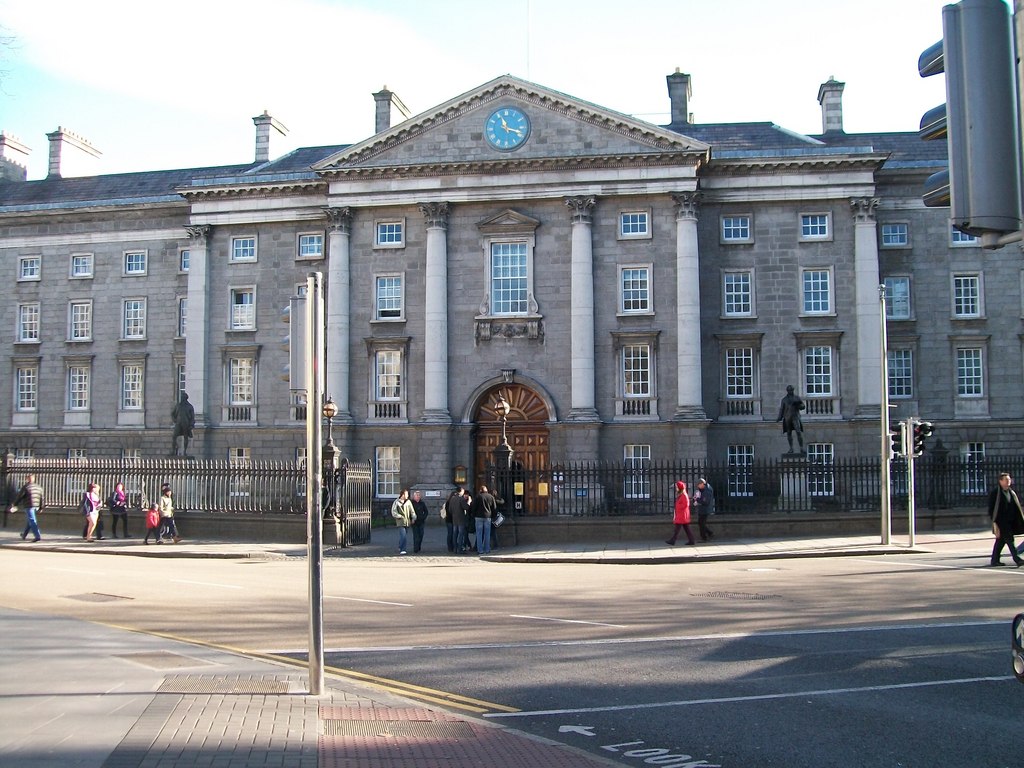

The first round of the Central Applications Office (CAO) has been released, and Trinity has made 3,976 offers, of which 58 per cent are for students’ first preference courses. Of all CAO applications, 13.6 per cent of students applying for Level 8 courses had Trinity as their first preference.
This compares to last year, where Trinity offered a record 4,059 places of which 60 per cent were for students’ first choice courses.
Cut-off points rose an average of 0.5 points across Single Honours Level 8 courses, where higher-points courses (above 500 in 2025) had points fall by an average of 2.3 where lower-points courses rose by 7.8.
Trinity’s Vice-Provost and Chief Academic Officer Orla Sheils acknowledges that while Leaving Certificate points have gone down slightly, previous years’ post-marking adjustments may be dragging CAO points higher. Sheils says “Although the adjustment is being phased out, its effects will persist for up to four years after its final removal, due to deferred entrants from earlier cohorts and the resulting turbulence in points attainment year on year.”

“To date, the reduction in the post-marking adjustment has not led to a fall in points for Trinity courses. Average entry points remain broadly unchanged, with some compression of the range as the highest points courses ease slightly and lower-points courses rise.“
Several courses saw notable changes. Medicine went from 739 to 741 points while Intellectual Disability nursing went up by 50 points to 388. English rose from 533 to 546. Computer Sciences combinations saw large drops, some falling by more than 100 points.
At a press conference today, Minister for Further and Higher Education, Research, Innovation and Science James Lawless acknowledged that the “high-point courses are seeing some moderation”, particularly pharmacy. He also pointed out that Dentistry is the only course with “massive points and random selection” in two out of its three offerings.
Lawless was also asked whether he will reform the leaving cert to alleviate the stress these exams have shown to cause. The Minister responded “it’s not so much the CAO process but what comes after it that creates the pressure point” and that we should value the “independence and transparency of the current system”.
He emphasised the importance of alternative options to the traditional university pathway, including general science and liberal arts degrees, apprenticeships and tertiary degrees outside the CAO.