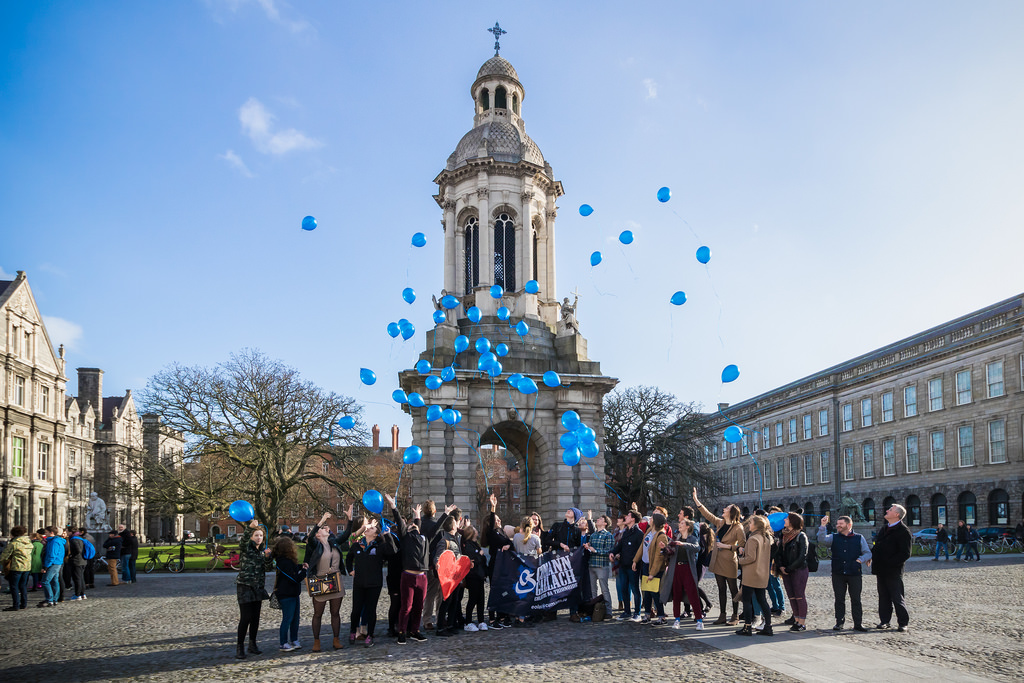

Balloons. A staple piece of party decor and a symbol of celebration and joy. Whether it be a confirmation, debs or birthday — was it really a cause for commemoration if your parents hadn’t ordered a bouquet of balloons with your name framed in the middle? I distinctly remember the morning following my Holy Communion, a canon celebration for Irish children, gazing lovingly at my bunch of balloons, swollen with helium and adorned with Holy Crosses and doves. In between mouthfuls of sugary cereal, the happiness and self-importance I derived from my ownership of these balloons made me think I would be able to hold onto them forever.
However, that feeling of finality those balloons brought me as a child reflect a much more insidious aspect about these omnipresent decorations. While these bright, big inflatables might seem inoffensively festive, that is unfortunately far from reality. Despite what some brands claim, there are currently no balloons on the market that are fully biodegradable. This means that all those balloons from our communions and other celebrations are still somewhere, rotting in a landfill and leaking toxic chemicals into wildlife. The threat of balloon waste especially targets marine life and birds. In 2019, the University of Tasmania found balloons to be “the highest-risk plastic debris item” for seabirds, over 32 times more lethal than any other hard plastics. The risk that discarded balloons pose as a choking hazard for animals paired with how long it takes for them to break down means that balloons have had much darker consequences for the world than most realise.
Despite this, the popularity of decorative balloons has soared, with the age of social media crowning balloons as the staple of any well-curated party decoration. Balloon hallways, arches and backdrops dominate any amateur party planner’s Instagram algorithm. While the movement against plastic straws has seemingly reached every McDonald’s in the world, balloons seem to have slipped under the radar of eco-activists and policy makers.

Meanwhile, countless companies claim to sell balloons marketed as eco-friendly, when they in reality are not. For example, the UK-based company Party Fox sells a range of balloons marketed as “eco-friendly” under the guise that they are made from 100 per cent natural tree latex, but omits details about the chemical processing of their balloons that in effect render them non-biodegradable.
And this is not limited to Party Fox. While nearly all balloons are indeed made from natural rubbers, these materials are altered to become more elastic and durable through a process of sulphur vulcanisation. This alteration of natural rubbers creates balloons with their intended properties but also means that they pose a serious environmental threat. The process of sulphur vulcanisation is in itself incredibly detrimental to wildlife, leaking toxic chemicals, wastewater and non-biodegradable waste into ecosystems.
These effects, paired with the sheer amount of discarded balloons, is what pushed Charlotte Melia, an environmentally conscious events entrepreneur, to fund doctoral research to find a solution. With Melia’s contribution, the department of Chemical Engineering at Imperial College London has worked on developing a truly biodegradable alternative.
Under the name of Bioloon, Cumming’s team worked to modify the process of balloon manufacturing in order to develop a version of balloons with properties more compatible with the environment. Like traditional balloons, Bioloons are also made from natural latex, but instead of being treated with harsh additives and toxic chemicals, they are processed by linking polymer chains together. Thus, Bioloon products avoid the environmentally harmful byproducts of sulphur vulcanisation, while retaining the stretchy and strong properties of a conventional balloon. Moreover, the researchers suggest that Bioloon technology could be extended to other latex-based products in medical and domestic fields, such as surgical gloves, baby pacifiers and condoms.
Regardless of where the Bioloon ends up, researchers say that it will break down fully within 9 months. After being tested “in soil, seawater and deionised water”, the Bioloon has become the world’s first fully biodegradable balloon. However, there are still limitations. The nine month window for decay means that there is still a period where wildlife is at risk of choking if Bioloon finds its way into the natural environment. Implementation might also be slowed by public resistance to the product, the same way other environmental programs like paper straws and attached bottle caps received pushback. While not a perfect solution, Bioloon promises a reduction in plastic waste, less toxic chemical leakage and ultimately, a step toward more sustainable societies.