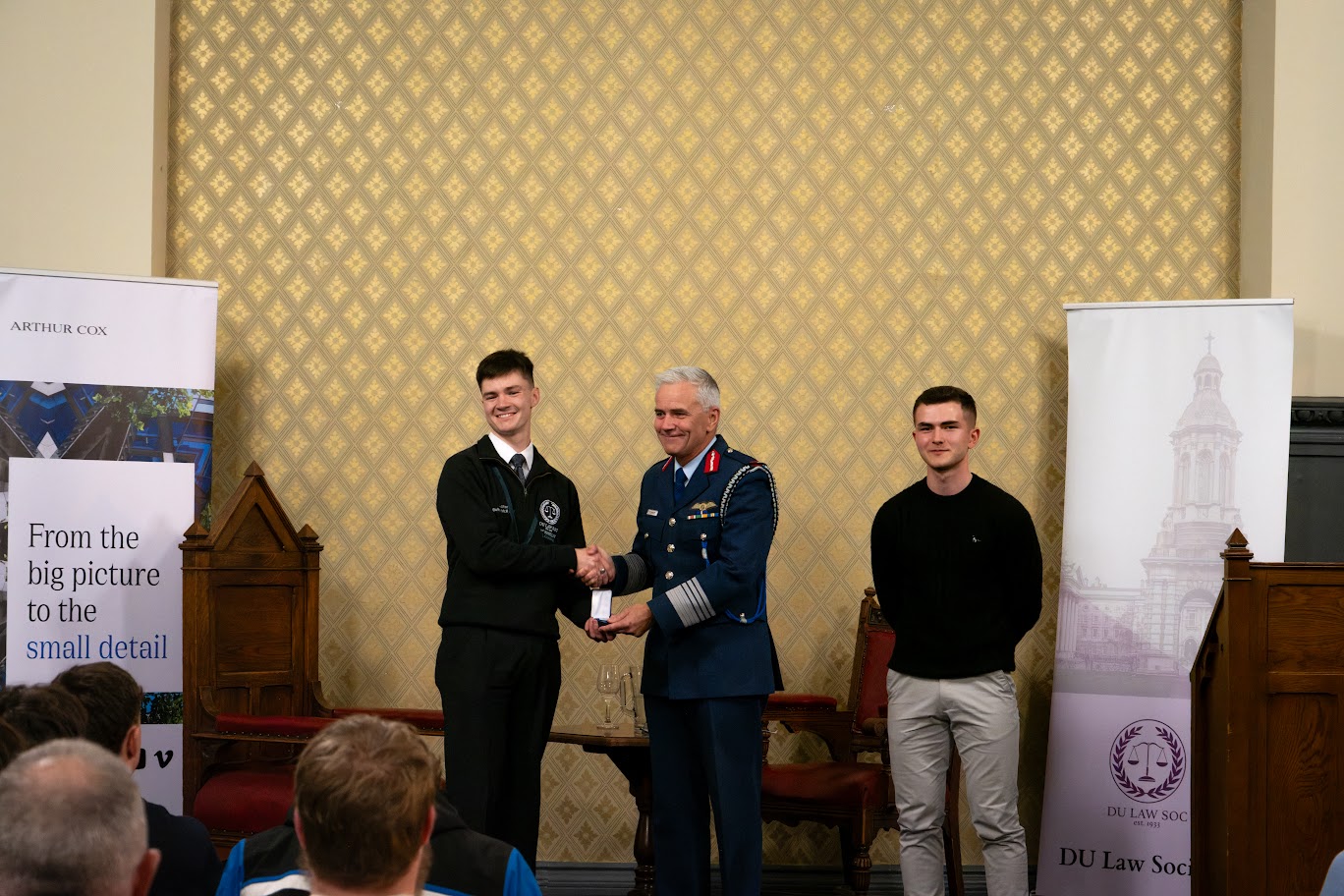

On Monday night, General Seán Clancy spoke to a crowded GMB to discuss his decorated military career, as well as the security challenges facing both Ireland, and the EU as a whole. The General spoke about his beginnings as a cadet in the Air Corps for the Defence Forces (during which time he completed a degree in Computer Science at Trinity), moving his way up the ranks over the following decades to eventually become the Chief of Staff of the Irish Army in 2021. He noted during this time the changing role of Ireland that came about with membership of the EU, a growing influence that this generation had a “responsibility” to contribute to.
As Chairman of the European Union Military Committee, the first Irish person to hold the position, Clancy spoke at length about the importance of the EU to security both within its borders and abroad, the latter through its Common Security and Defence Policy. He praised NATO, of which 23 EU states were members of, as a “central pillar of deterrence” but recognised the different relationship Ireland held with the body due to its policy of neutrality. He also highlighted that the continent now faced the most complex security situation in decades, referencing the Russian invasion of Ukraine when speaking about how Eastern European nations were now feeling “the breath of the bear”. In his view, the world was reverting back to great power competition, with powerful states explicitly disregarding international law.
Clancy further detailed the prevalence of so-called “hybrid attacks” that were occurring against EU Member States, referencing those threats not confined to physical infrastructure but rather the likes of cyber security as well as misinformation predicated on exploiting “strategic vulnerabilities”. The General argued that this can only be combatted through European unity, praising what the bloc represents through the cooperation of its Member States.

He specifically noted the high support for EU membership amongst the Irish population which he concluded was the result of the benefits of integration to the country. Clancy highlighted his appointment as Chairman was evidential of the fact that Ireland can enable defensive cooperation in Europe whilst maintaining its own sovereignty. He ended his speech by urging the students within the audience to be proud of Ireland as well as their identity as Europeans, stating that the “Europe that comes will be shaped by your choices”.
On the question of the EU’s relationship with the US, the General noted that whilst it has recently been “tested”, the transatlantic relationship has endured for centuries. He commented on the impact of the war in Ukraine on US exports of military equipment, which has seen a drastic increase since the conflict began, highlighting his point. However, he criticised a trend of underinvestment in security that has occurred within the EU, leaving Member States vulnerable to attacks like that seen in Irish and continental supermarkets last week. A holistic approach, in his view, is therefore needed, referencing the Emergency Security Protocol proposed by President of the European Commission Urusla van der Leyen in her State of the Union address this year to ensure a coordinated European response against hybrid threats.
Although Clancy refused to give his own opinion on the Irish Government’s controversial plans to remove the triple lock, noting it was a “sovereign decision” to be taken by them, he acknowledged that Ireland must be able to function as a sovereign state, and that Ireland was involved in peacekeeping before there ever was a Triple Lock, which he hoped would be maintained. He also criticised the debate over a future EU army as “disruptive”, arguing that the bloc cannot afford such and that the vast majority of Member States were already protected by their membership of NATO.
The event itself drew controversy from different sections of the student body. The Student Neutrality Front condemned the event, arguing that Clancy “furthers the NATO agenda, increased militarisation, and imperialism in its purest form” in a post on Instagram after the talk was held. There was mixed commentary from our own readership, with one reader criticising him as “a betrayal of [James] Connolly and our Proclamation” whilst another stated the Law Society should host him “as an accomplished Irishman in a senior military position where our role in defence is under major debate”. His visit to campus coincides with the upcoming meeting of the EU Heads of State in Dublin on Thursday.