
Recently, my incessant and mindless doomscrolling has been interrupted by an unexpected entrant to my otherwise curated social media algorithm: bears, or “fat bears” to be exact. I can’t help but question what internet activity could have conjured up this grotesquely disproportionate amount of bear-related material. Luckily, a deeply journalistic investigation into the matter has left me slightly less worried about my digital footprint.
In an interesting turn of events, the accelerating appearance of fluffy, brown chonkers has little to do with my own subconscious desire for bear content, and is rather the result of a marketing push for the most promising event of the year: Fat Bear Week.
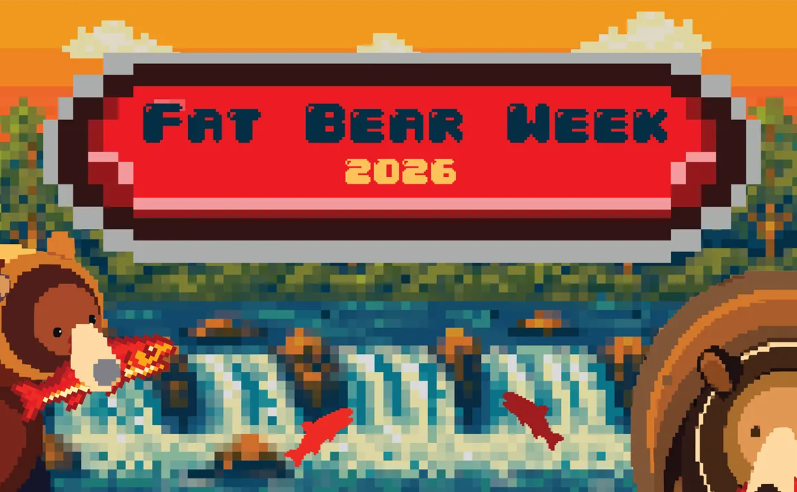
Every autumn, Katmai National Park and Preserve on the southern coast of Alaska hosts its annual Fat Bear Week contest. Dating back to 2014, Fat Bear Week originated as Fat Bear Tuesday aiming to show off the resiliency of the brown bears who put on kilos from June to September to survive winter hibernation.

Now in its twelfth year, the celebration of these towering titans spans a week in the end of September or early October. This year’s competition is just kicking off, with polls opening Tuesday, September 22ⁿᵈ and running until the 29ᵗʰ. Throughout the period, the public can have their say in once off eliminations, which culminates in the crowning of the fattest bear with the highest level of aura. The official Fat Bear Week website encourages you to “vote for the bear you believe best exemplifies fatness and success”. I suppose bear-uty really is in the eyes of the beholder.
There are 16 bears competing for this year’s title and the grand prize of “winning and surviving another winter season”. The complete list of beefcakes is sectioned off into groups: “Bear Families”, “Subadults”, “Single Adult Females” and “Adult Males”.
While most bears will go by numerals, such as the 806 family, some bears (presumably the BNOCs of the bear world) have earned additional nicknames which correspond to their general stature and fatness. One example is last year’s champion, the beloved “Chunk”, who is predicted to make a comeback this year; new names include the revered “Backpack” and my personal favorite “Marshmallow”.
I’ve been following Fat Bear Week closely since last year, when I came across an article I can only liken to the poetry of Wordsworth. My favorite line arising from this ordeal was conceived by Alaska News Source in their reporting on the tightening competition between the bears: “The race may be getting thinner, but these bears sure aren’t,” they wrote.
With lines like “The burliest bruin carrying the thickest and chubbiest tummy of all”, the mainstream media has taken it upon themselves to cover this voluminous event. Last year, CBS News reported of one contestant, 901, that “she’s described as a rectangle and a cruise ship because of how large she is”.
Not every bear has been granted a slightly derogatory name, and few have caught the strays of American broadcasting networks, but one thing is true for all of them: they sure are voluptuous. And boy are they adorable.
My hyperfixation on this contest and subsequent parasocial relationship to these bears knows no bounds. I’ve become intimately involved in their lives, their successes, their survival and their tragedies.
After my annual deep dive into the contestants of this year, I recognised multiple names, but one struck me especially. To my own amazement, 901 has gone from a lonely ship cruising the seven seas, to a small fleet of rectangular wonders: she has become a mother. This year, 901 is competing in this “battle of the chunkiest” with her Spring Cub — a tiny sized future behemoth who likely will take after her mother.
Though 901 now competes with her precious gem, their story is one of tragedy and perseverance. No cubs from her first litter survived and of her two cubs in 2026, only one remains, the other having disappeared in June. “901’s parental efforts have demonstrated her ability to work through loss. She knows the river well. She is a good angler. Her surviving cub has grown to become one of the largest at the river this year. Sudden loss and change have been part of 901’s life so far, but we also see her success reflected in her body size and the health of her cub,” explore.org, the official website of Fat Bear Week, writes.
Similar stories crowd the webpage “meet the bears”: 909 began the season with newborn cubs, but has since lost her entire litter, one of which was killed by another mother bear.
Then there are the, altogether more uplifting, honestly quite hilarious, contenders. In addition to the wonderful sight of their big, chunky bodies, the biographies are in themselves entertaining. One case that had me subtly giggling in front of my computer screen, was the endearing description of Bucky: “Large amounts of food allow bears to grow fast, and Bucky has grown a lot during the last few years. A change in attitude accompanied his increase in size. Bucky is able — and often willing — to displace most other bears from preferred fishing spots”. I see you, Bucky. We are cut from the same cloth…
Although incredibly humorous as a concept, the contest also highlights the circumstances and habitats that allow for these bears to grow big and bootylicious. Fat Bear Week is, at its most utilitarian, meant to promote conservation and appreciation for these national sanctuaries.
Katmai boasts 4.2 million acres of intact ecosystems — that is, land that remains undamaged by human activity and/or interference. National Parks allow for these systems to flourish. Impede on the land that is protected, extract, destroy, fell, and all that disappears. The successes of these bears will soon be reflective of our success as human beings — as supposed stewards of this world we inhabit (if that is the lens through which you choose to see our responsibility in the climate and environmental crisis.)
Under Trump’s derangement, the current Republican government has decided nature isn’t enough value in itself. His wars range broad — and not even nature is exempt.
The executive order “UNLEASHING ALASKA’S EXTRAORDINARY RESOURCE POTENTIAL” signed in January of 2025, essentially encouraged free pillaging of Alaskan nature. Under the guise of “unlocking this bounty of natural wealth” in order to “raise the prosperity of our citizens while helping to enhance our Nation’s economic and national security for generations to come,” it becomes clear what Trump, and his cabinet, define as valuable.
Ecosystems are connected in more intricate ways than account for merely geographical distance. Allowing a destabilising of Alaskan nature will have an impact on every aspect of not only the local environment and culture, but globally as well — if not only for serving as precedent that these rich and complex hubs can be sold to the highest bidder without regard for the lives contained within (not that they haven’t been for the past hundred years).
Trump’s attack on the natural world exemplifies the greed of late stage capitalism accompanied by a psychopathic disregard for the intrinsic value of life. While claiming to support the lives of Americans by extracting natural resources, it may still be unclear to many citizens — not only Americans — living in 2026 what good this greed may bring. What does bring value, in times of economic and existential uncertainty, could be the child roaming in the forest, speaking to the squirrels, the family voting for the fattest bear of the pack. We could seek value in ensuring a future for the nation so proudly boasting to protect its population; we could protect all life, not just human animals.
Perhaps a fat bear contest will do little to actually save the bears, their habitat and our sorrowful extractive souls. Nonetheless, the marriage of humour and conservation could prove a strong tool in fighting for the climate and all the amazing creatures that humans share a planet with. Uniting human culture, language, the need to connect over shared experiences — and our pathological inclination to seek giggles wherever we can — may be our last bastion of resistance in a political system dominated by monopoly men and wannabe monarchs.
Bets are on for the biggest chungus of the year, and I sure know that no matter which one of these adorable furballs takes the cake (literally), they’ll all be winners in my book.