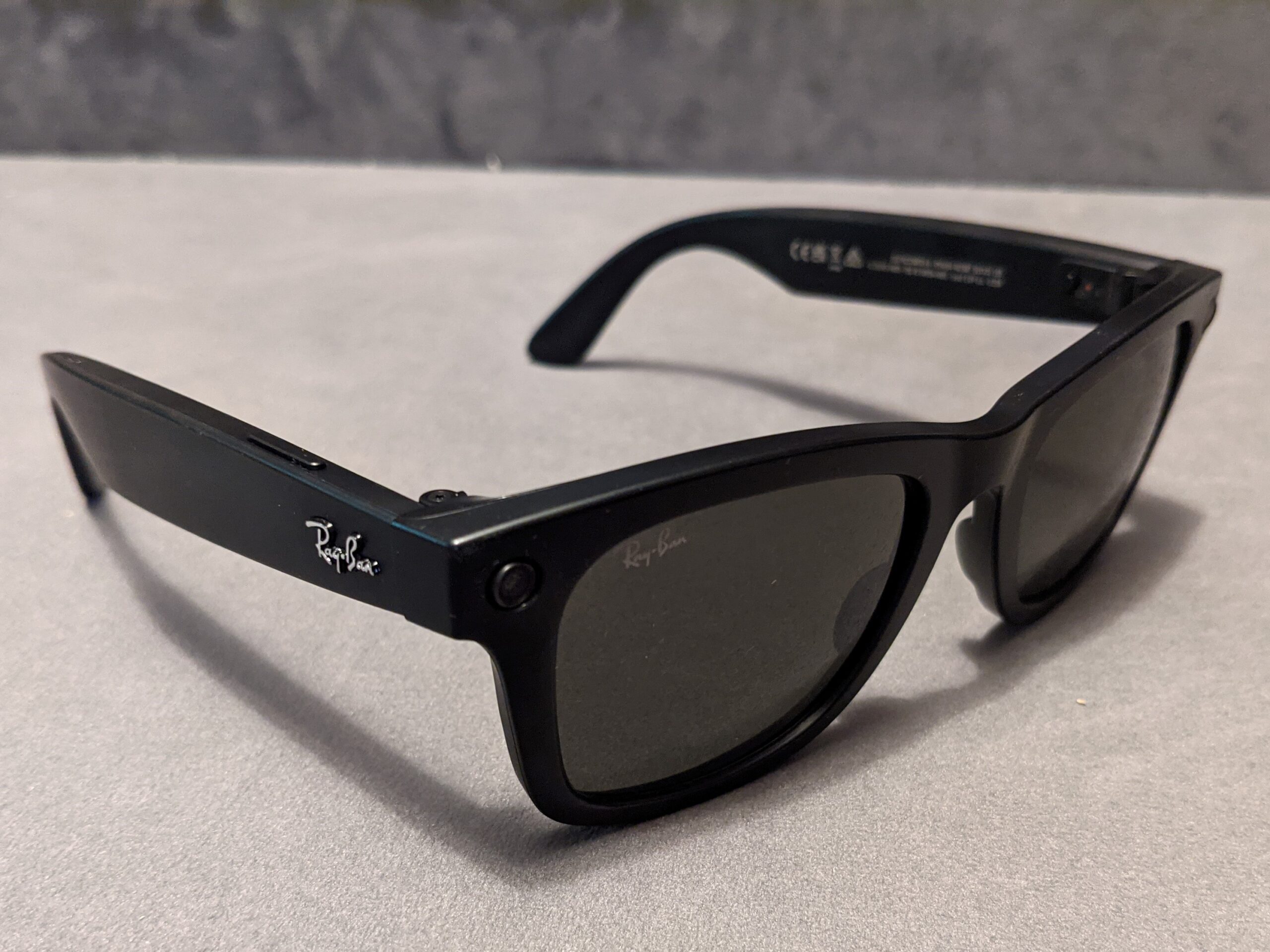

Do you ever feel like you are being secretly watched in public? As though there is someone you cannot see, calculating and recording your every move? Well, in the wake of Zuckerberg’s new Meta glasses, this could unfortunately be true. Mark Zuckerberg, CEO of Meta, has recently collaborated with Ray-Ban to create Meta Ray-Ban AI Glasses. However, what seems like another harmless consumerist plant has sinister connotations that many individuals have refused to ignore. We must acknowledge the dark world of new AI technology before it spirals out of control. Meta glasses are a gateway to a widespread, inconspicuous form of surveillance; they are a stepping stone towards a world where privacy is a privilege. This isn’t your next big purchase, this is your new nightmare.
Meta Ray-Ban glasses resemble regular glasses with added features that allow users to record footage through their lens as well as make use of AI tools. The New York Times revealed that Meta has plans to introduce an AI powered tool which would enable users to scan and identify other individuals using their glasses. The limits of AI glasses are not yet known, and the public face this fact with fear. A Meta representative, Tracy Clayton, said “the onus is ultimately on individual people to not actively exploit it”. But when we give people the tools to exploit others, a symbol of their wealth delivered to them in fancy packaging, are we supposed to thus ignore the unethical motives of its billionaire producer and blame the consumer? Meta glasses are like knives disguised as pens; if the product was ethical, why is it hidden beneath a facade?

Social media has been home to the Meta glasses discourse these past few months, as the product begins to infiltrate countries outside of the US. Although the majority of contributors to this discussion have voiced their opposition to the product, a minority have emerged to vouch for the glasses’ potential to be an aid against crime. For example, some women believe that Meta glasses can assist victims of violence and abuse by having secret film footage to help their case in court. But should we really promote the notion that women need to be secretly filming their abuser in order to be believed by a judge? Meta glasses have never been marketed by their producer as a safety aid; people have twisted its brand to get apprehensive women on their side. Mark Zuckerberg even paid Kylie Jenner to market his product as desirable to a female gaze. Do not be fooled. Meta is not here to help you, they are here to buy you.
We have already seen how the general public have abused Meta glasses for their own enjoyment. Apps like TikTok and Instagram have been flooded with videos filmed by Meta glasses which showcase inappropriate pranks or intrusive street interviews, usually having young women as their targets. Women working in retail or food service are being non-consensually and unknowingly filmed by customers who aim to evoke a “funny” reaction from them for people on the internet to jeer at. Men secretly film young women going on nights out using their glasses, shaming them for their outfits or figures. Remarks like “they shouldn’t be dressed like that if they don’t want backlash” flood the comment sections of these viral videos, reiterating the victim blaming culture we are so desperately trying to push past. People claim Meta glasses have a purpose in crime defence; tell that to the women who have been victims of nonconsensual filming and thus harassment online. Tell that to the women who have been videoed by medical practitioners, gynaecologists and estheticians. Tell that to elderly or vulnerable citizens, who are oblivious to the secret red light that’s meant to indicate that you are being filmed. We should not endorse a product which promotes a culture where leaving your house means you consent to being unknowingly recorded.
In the past, we have seen similar products try to succeed in the market and fail. Google released their own smart glasses called “Glass Explorers” in 2013, which BBC News declared a “failure” in 2014. This was after the company received backlash over the product’s awkward appearance, high cost but also over major privacy concerns. We should not treat Meta with any less disrespect. Now, in an era where AI has infected every online platform and is only growing more powerful, Meta’s version of smart glasses only poses more risks than Google ever did. It won’t be long until we are able to alter footage via Meta glasses altogether. It won’t be long until children become addicted to the world they can create with their glasses as opposed to the reality they aim to escape. Meta faced an 18 billion dollar lawsuit in the US due to its damages to children using their various applications. Should we really welcome their new product with open arms knowing the risks they are capable of?
Reiterating the possible benefits of AI glasses is a cop out from the proven dangers it has already inflicted. Meta does not care about protection, they care about profits. When we decide that money is more important than the agency of the average person, we only further corruption. However, there is a chance we cannot avoid Meta glasses. There is a chance they will collaborate with various brands until we cannot differentiate between normal glasses and AI versions. There is a chance the majority of consumers will accept their dominance in the market, like iPhones and AirPods. But if there is even a miniscule chance we can reject them before the product is too widespread, there is no doubt that this is the right path. The internet is already a dark place; we do not need to allow dangerous technology into the open. We do not need to allow Mark Zuckerberg to profit off of absent consent. We do not need to welcome AI into our streets. We do not need to let it win.