
College has just confirmed that all teaching activities will be cancelled on Wednesday, October 14th, due to the upcoming strike. The college has also confirmed that campus will remain accessible to staff, students, residents, and contractors for essential work, but it will be closed to the public.
College Green buildings, Foster Place, the School of Nursing and Midwifery, South Leinster Street, and St James’s Hospital.
Events on October 14th, the College said, are either cancelled or postponed.

The college also said the libraries, catering outlets, and the Sports Centre may face disruption or be closed.
All graduation (commencement) ceremonies scheduled for the day will be rescheduled to October 19th, and students may opt to graduate in absentia.
College events including lectures, tutorials, and laboratory teaching were cancelled in conjunction with the stoppage from 12pm to 1pm last Monday. Further 24-hour strikes were expected to take place on the 14th and 21st of the month, where most public sector government services will also cease with only essential services available. The strike next Wednesday has now just been confirmed.
During the hour-long strike on Monday, the Irish Federation of University Teachers (IFUT) in allyship with the Postgraduate Workers Organisation (PWO) gathered peacefully on the steps of the dining hall on National Teachers’ Day to demand a fair pay settlement for the year and better working conditions for all professions the union represents. As part of a nation-wide stand in solidarity with dozens of trade unions working in the public sector, the IFUT is calling upon the Irish government to negotiate and renew a fair pay settlement that expired June 30th.
“Trinity respects the legal right of individuals to participate in lawful industrial action and equally respects the decisions of those who choose not to participate”, said Dr. Shields and Dr. McManus in the College-wide statement. Trinity announced a cancellation or postponing of all campus events on the 14th, and has established a preparedness group headed by Chief Operating Officer to ensure the “continuation of essential College services and activities”.
Further information from the preparedness group will release as the 24-hour strikes approach. Trinity will likely have “only limited, essential services available” to students and staff. College spokeswoman Catherine O’Mahoney affirmed Trinity’s dedication to monitoring the situation and remaining in touch with IFUT over the coming weeks.
The strikes and industrial action come as a last resort by the union to push for fair pay and better working conditions for all employees of the University and higher education institutions. As high inflation rates and the growing accommodation crisis continue to impact Irish residents, public sector workers aim to negotiate a pay resolution accommodating prices that outpace wages.
The country’s biggest trade unions, including, Services, Industrial, Professional and Technical Union (Siptu), Forsa, and Irish Nurses and Midwives Organisation (INMO) members overwhelmingly voted on internal ballots last month to take industrial action. Formal talks to negotiate a successor agreement have yet to begin between unions and the government.
Public sector workers have faced criticism from the government. Minister for Public Expenditure Jack Chambers said they are “unwilling to sit down and engage”. Foreign Affairs Minister Helen McEntee also criticised the industrial action, urging unions to come with “no preconditions when we engage in these talks” and said the strikes “won’t benefit anybody”.
Since the 2008 financial crisis, the public sector has yet to fully recover from the loss of core funding that was slashed and never fully restored. The IFUT, as both a union and Seanad nominating body, has said it seeks to participate in good-faith negotiations in hopes to alleviate the issues facing higher education employees in the current market.
IFUT claims that it has exerted all proper avenues of communication with the Ministry of Further and Higher Education and has still come out empty-handed. In an open letter to Minister for Further and Higher Education James Lawless, IFUT noted its concerns with the state of research funding for universities across the country. Proposed changes by the government will devolve funding allocation from the Government of Ireland fellowship programme to universities themselves, increasing precarity and stagnating career advancement for early-career researchers, particularly those pursuing a PhD.
Established in 2023, the PWO works to ensure the recognition of postgraduates and specifically PhD researchers. Technically classified as students, postgraduates are not eligible for workers’ rights or protections like those afforded to formal employees of their respective universities, despite significant contributions to research, teaching, and general support to the institution. Ireland is one of the few countries in Europe that lacks worker recognition for PhD researchers, creating extreme difficulties for postgraduates to support themselves or their spouses and families, receiving a fixed non-taxed stipend of twenty-five thousand per annum. As a result of paying no income tax, postgraduate researchers do not qualify for government benefits like Pay Related Social Insurance (PRSI), social welfare, or pension, among others. The IFUT cannot allow any postgraduates to have membership and receive protection as members of the union because they do not technically qualify as workers and employees of Trinity. The IFUT extends support and allyship to the PWO and is pushing for postgraduates, in particular PhD researchers, to be formally recognised as workers within higher education and therefore receive government benefits and have access to unionisation.
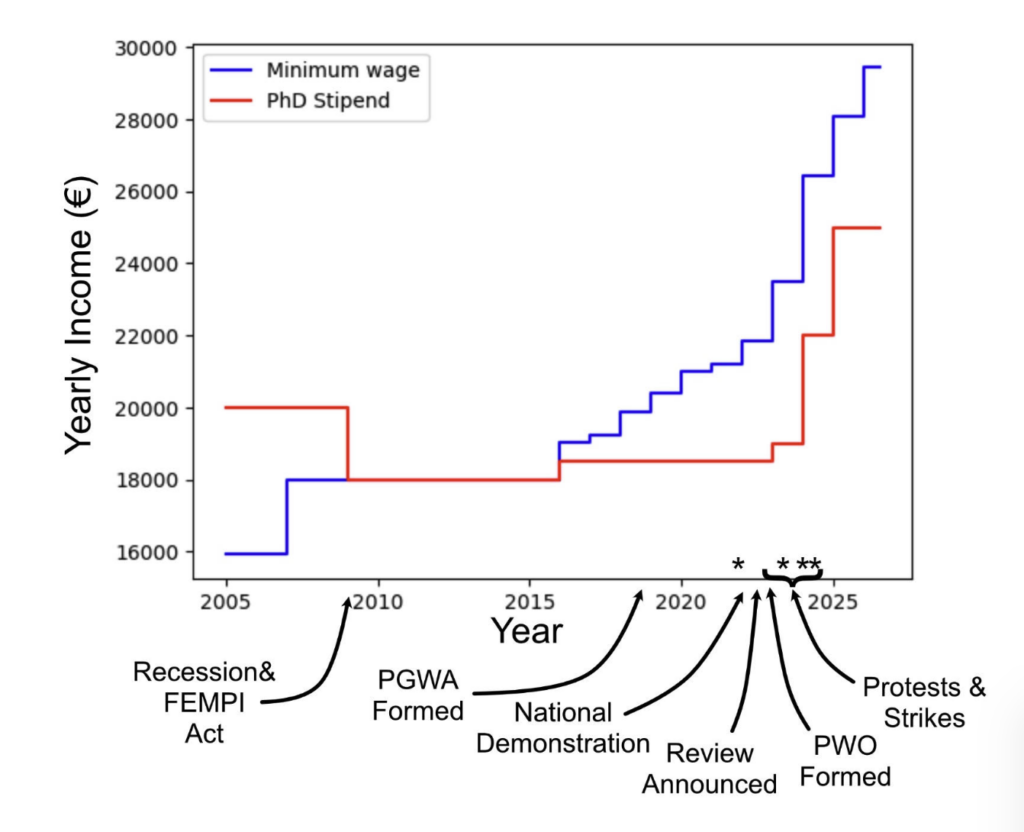
This graph shows how minimum wage has steadily overtaken PhD stipends
In an email to the University Times, TCD-PWO President Daniel Ó Laocha said “We are asking students to stand with postgraduate workers alongside all university staff, support the industrial action, encourage students not to cross the picket line, and help inform students about why this action is taking place”.
The PWO spoke to the TCDSU/AMLCT prior to the strike, affirming their opposition of fees for students and supporting increased funding to amend the €250 million funding gap across Irish universities. Alongside undergraduate students, postgraduate researchers, professors, and university staff all face “extortionate costs” impacting quality of life and cost of living as Irish residents. The University Times spoke to SU Graduate Officer Ava Tuohy, who agreed that postgraduate researchers face unique challenges that inhibit their ability to live and work at College. Much of that is not at the fault of Trinity, but of the lack of recognition of PhD researchers as workers instead of students. For students experiencing cancellations as a result of the strikes, Tuohy recommends taking “a break from the library and just go out with [protesters] and stand with them and show solidarity”.
In a press release, the PWO wrote: “Graduate researchers have no power in Irish universities”. “We are powerless alone. Together, everyone who works in the university can make a difference by standing up for each other and what is right”.
Additional reporting by Harper Alderson