
Four and a half months of vacation, I think anyone can agree (except maybe med students), is long. Sure, it sounds great at the start, especially after a stressful term (except for maybe philosophy students). But after some trips, an internship, a j*b, whatever – the novelty of it fades. It is likely that at some point during such a long vacation, you will find yourself being bored. That’s fine. It’s normal. Maybe you pick up an old book. Maybe you start calisthenics. Maybe you do a crossword, or just scroll on TikTok.
The point is, being bored isn’t that big a deal. We always find things to do. A common phrase for these things we find to do is a pastime’: something for time to pass by quicker when we feel we have too much of it. But what exactly could that mean? Isn’t time, after all, something that passes regardless of what we are doing? In some sense, time seems close to space: they’re both just there, as basic features of our reality. Do we often complain that we literally have too much (apart from cramped student accommodation) or too little space in our lives? What’s so big of an issue with having an empty hour ahead of us that we need something to do with it? What, then, does the word ‘pastime’ and the nature of that activity reveal, fundamentally, about our relationship with time?

It seems that when we talk of a ‘pastime’, it is because time appears too long to us. The long time is boring, and so it needs to be past. And even though this might be particularly common on vacation, it can happen whenever, really. Maybe life is simply this really long stretch of time we just have to wait out. Since waiting out the length of a full lifetime would probably be really boring, we find activities to do. Some philosophers (yes, it’s really starting now) propose that nearly all our activities are really some kind of distraction. Now, there are many perspectives on what we are distracting ourselves from, but we could reasonably suggest that we find activities to do because doing nothing would be really boring. Maybe that’s activities as simple as colouring or playing football when we’re kids. Maybe this even extends to bigger activities, like buying a house or getting married. How could we draw a limit? What’s even more strange, perhaps, is the fact that we need time to be occupied at all. Because, intuitively, we know that a bunch of empty time seems really boring. But why? What’s so bad about having time ahead without any plan for it? Why do we need activities so bad?
The French philosopher Pascal calls this divertissement (which basically means distraction, shoutout to FrenchSoc). He imagines someone that was put in a room alone. After a while, they’d probably start being bored. Maybe this boredom would make them confront some deeper issues, like their uncertainty or mortality. In Pascal’s sense, maybe we find activities to do because we’re scared, not really of boredom, but worse things, like death – literally, the end of time. But this seems strange. We just established that we use pastimes to pass time quicker. How can the problem be that we’re scared of time ending, yet we simultaneously look for ways to make it pass by quicker?
When college restarts, I’m sure many of us have felt like time is scarce and precious. There is, after all, so much to do, and so little time to do it. There’s deadlines, lectures, assignments, work. There’s nights out, pubs, societies. You still want to make sure you’re doing some sports a few times a week. And of course, you want to be eating well, so that’s some time to put aside for groceries and cooking. And then maybe you want to pick up something new as well, like knitting or karate. That seems like a lot of stuff to do. And so we start allocating bits of time to certain things, and other bits to others. (Some of us) plan our schedules. We speak of ‘saving’ or ‘killing’ time, ‘spending’ or ‘wasting’ time, ‘using’ or ‘making’ time. We end up treating time as a currency. Almost like that movie with Justin Timberlake, In Time (I haven’t seen it, but I kinda got the idea from a YouTube short). This way of treating time is especially prevalent in 21st century work and hustle culture (can you tell I’m looking for an internship?). There’s a million reels out there telling you how to spend or save your time better. We even speak of ‘time management’. How? Time passes exactly the same anyways. Does anyone speak of ‘space management’? This kind of obsession over how we use time seems strange. It also seems strange how we can go from having way too much time, such that we are bored by it, to feeling like we don’t really have any time to do the things we want.
The German philosopher Schopenhauer has a pretty good explanation for this (he’s not exactly the happiest guy though, so this might seem a bit pessimistic). To him, human beings are pretty much solely driven by our desires: food, sex, success, fame, money, friendship, whatever. We want things. And our lives are pretty much determined by that. Because when we want things and don’t have them, we suffer. We lack, we’re dissatisfied. But then, sometimes, we do end up getting that thing – and what happens? Well, we got it. What’s next? And so on. In this way life ends up being this oscillation between suffering and boredom. Could this work for college somehow? During term time, we have a hundred things to do and sometimes it can feel like a lot. Like too little time, so we look for relief. Then comes summer, and we feel relieved. It’s pretty great. But then four and a half months settle in, and that maybe starts seeming a bit long. That’s boredom. And that’s where we find things to do. Again, we can ask: what’s so bad about empty time?
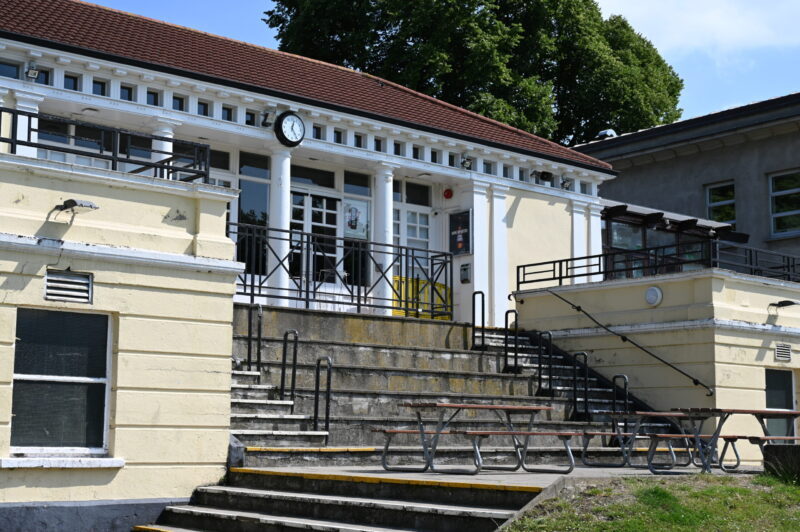
This, on a smaller scale, is how we get to the Pav-Ussher Paradox. Sometimes you’ll find yourself in the Ussher, thinking ‘damn, I wish this day would end sooner’ since college work is famously really boring. Other times you’re trying to get as much as you can done in the little time you have, so you can ‘save time’ for later. The same can apply to the Pav. Sometimes you’re just chilling there because your next lecture’s much later and you’ve got nothing urgent to do for now; you’re ‘killing time’. Other times, it’s Friday, you’re on your sixth can, you’re feeling great, and then you hear: ‘closing in an hour’. Some days we have no idea what to do. Other times we’ll look back and think, where’d the past few years go? All in all, we can simultaneously want more or less time, whether that’s in the Pav or in the Ussher (usually goes more Pav and less Ussher, but that’s besides my point here). But again, why? Time’s just there. Why do we always look for more or less of it?
We all say college seems too short every now and then. We’ve all heard these are your best years, enjoy them, etc. We all know life won’t last forever. In fact, you’ve probably seen something like this before:
I don’t know about you, but to me that makes it seem like a lot’s gone already. This can make us worry: are we enjoying this time enough? If you’ve seen Dead Poet’s Society, you’ve heard the phrase ‘carpe diem’. If not, you’ve probably still heard it. It’s one of those phrases that’s just everywhere. Literally, it means ‘pluck the day’, though we often hear it as ‘seize the day’. The goal of it is to encourage us to enjoy the present moment, stop thinking about the past or future, blah, blah, blah. This brings a kind of reversal of our initial problem. We know time is always the same. Yet we still seek to control or manage it. Carpe diem accepts this first premise: time is just time. What matters, and what makes time feel more lived in, is about the kind of attention we bring to our life. If we’re just thinking about now, what does it matter whether time overall seemed short or long? And maybe, what carpe diem seems to say is that this can make us appreciate things more.
But this might introduce another problem (happens a lot in philosophy). Because if we are really meant to consciously pay attention to every moment, we might equally be worried: am I paying enough attention? Say, you’re having a nice dinner with your friends. You know that it’s nice; you also know that it won’t last forever and that you ought to enjoy it now. This produces a kind of self-monitoring about whether you’re enjoying it enough. For we can always imagine we were more present than we are now. And in doing so, you destroy your presence at that dinner. You can’t be present and simultaneously evaluate if you’re present enough. Yet we could also feel bad if we feel like we weren’t trying to be present enough, either. Thus, we might be stuck between a kind of anxiety when we’re conscious of time (in the moment) vs. a kind of regret for having been too unconscious of time (when we think about it afterwards). So carpe diem can perhaps serve as a good reminder, but it’s also pretty good at making us less present if we think about it too much.
Let’s return to the initial problem of pastimes. We interpreted pastimes as trying to pass time, because it felt too long. But the problem with carpe diem can perhaps give us a new perspective. Because pastimes are also valuable for making us not think of time. We’re just doing something in the moment. We don’t know how long it’ll last. It might not always be for something either (crosswords are pretty useless). And maybe that’s precisely what makes it valuable. We’re not thinking of using time for anything but just living through it.
This connects nicely with what Aristotle (last one, I swear) said about leisure, or scholē if you like old Greek words. To him, leisure isn’t simply time outside of work. It’s more like the end goal of work. Usually, when we work, we work for something else; that is, work is instrumental. When we enjoy pastimes, however, we do them for their own sake. Because you can always justify running as ‘at least I’m staying fit’. You can justify reading as ‘at least I’m learning’. It’s hard to justify doing a crossword for something, and that’s the point. In doing so, that might be the most present we can really be. The same goes for hanging out with friends, playing cards, enjoying good food, fishing, and listening to music. The value of these activities isn’t postponed instrumentally. They’re just there, like time really is.
Maybe we can worry that since our lives as a whole seem short, leisure is kind of a dumb activity to be spending it on. Why do crosswords when you can become president? But this rests on a flawed assumption: that the purpose of life is anything but living. Time wasted for nothing could be the best thing we could do with our time. Obviously not all the time, since we do have responsibilities. But these kinds of activities are perhaps those we experience most fully.
Have you ever seen that AIB ad on YouTube, where they say ‘because life isn’t measured in years, but in moments’? Weirdly enough, it suits the point I’m trying to get at pretty well. We saw that sometimes we feel like we have too much time, and we try to kill it. Other times, we have a lot of stuff going on, and we feel like we don’t have enough in such a short life. So maybe we tell ourselves we just need to live in the present; carpe diem. But paradoxically, trying to enjoy present time can make us more acutely self-conscious of our enjoyment. Perhaps the point, then, isn’t becoming better at using our time but at finding activities where we don’t feel the need to use it at all. In sum, this brings us from the initial problem of why we need distraction to the question of whether activities really are distractions at all or really, just what a life is made up of.
The strange thing may not be whether we fundamentally have too much or too little time, after sometimes feeling one, other times the other. The strange thing might be the idea that we ought to have any amount of time at all. Anyway, I’d like to talk about this longer, but the Pav closes in ten minutes.