
On September 6th, supporters of Maghreb Fez, Morocco’s current football champions, displayed a banner that read “Ceuta and Melilla. Two cities, one homeland: Morocco” during an African Champions League match against Rahimo of Burkina Faso.
Two days earlier, on September 4th, Sevilla’s football team Real Betis hosted Real Madrid in their home city for La Liga (Spain’s football competition). Two flags were unfurled on the pitch: Ceuta’s black and white, and Spain’s red and yellow. Many fans waved their own flags and chanted “Viva España”. In addition, the national anthem was played, which is not usual for La Liga matches.
Moreover, players from both sides were asked to wear T-shirts with a message on the front reading: “Todos somos Caballas” (a nickname for people from Ceuta). Underneath, a message in smaller font read: “In solidarity with the autonomous city of Ceuta” and on the back of the T-shirt was the coat of arms of Spain with the message “our city, our passion”.

Mbappé, Vinicius Jr and Konaté folded up the shirts so only the “We’re all Caballas” message could be seen. Mbappe explained in an interview with AS magazine the reason why he did this: “The first thing I want to say is that I have all my solidarity with Ceuta and with all the victims. Because before being a player, I am a human being”.
The French footballer continues: “But I also wanted to show a gesture and express a thought for all the immigrants who have lost their lives and who are also living in very difficult conditions. It was not an easy position; it was difficult, because in the end people might think that I am against the people of Ceuta, but no, absolutely not. I have nothing against them, and I support them 100 per cent with my thoughts. But I also wanted to spare a thought for all the people who are suffering, because at the end of the day I am human and I don’t want to rank or prioritise suffering.”
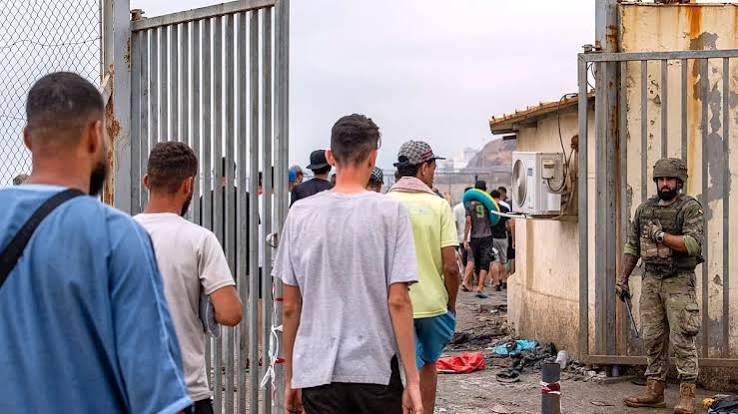
Mbappé’s comments shed light on the false dilemma in the Ceuta migration crisis: that it was either a violation of Spain’s territorial integrity or a humanitarian crisis. It was both; that is the tragedy. Ignoring that it is both is an even bigger tragedy.
Some historical background: the city of Ceuta, which is surrounded by Morocco along a five-mile-long border, dates back to the Phoenician era and has been under either Portuguese or Spanish control since 1415. Therefore, Ceuta had been part of the Castilian crown for around 250 years before the formation of the Moroccan state, as the Alaouite dynasty began its reign only in 1666.
In fact, Ceuta and Melilla never formed part of Spain’s Moroccan Protectorate. The two enclaves retained, without interruption, their status as national territory under full Spanish sovereignty. This is why, to this day, the UN does not consider them colonies or include them in any list of territories to be decolonised. In fact, with the entry into force of their Statutes of Autonomy in 1995, they were consolidated as Autonomous Cities, fully integrated into the EU and represented in the Spanish Congress and Senate.
In short, allegations about the so-called “colonial roots” of Ceuta and Melilla lack historical evidence and at best reflect Rabat’s short-term geopolitical strategies arising from the migration crisis.
The reasons for this last migratory surge are not entirely clear, but we can make a good guess. Spain’s Prime Minister Pedro Sánchez blamed human trafficking networks, which he says misled migrants about how easy it would be to remain in Spanish territory or get to mainland Europe. Though usually Moroccan officials indeed make it hard for migrants to get close to Ceuta, several migrants assured that that week the Moroccan police waved them through the border. Thus, Sánchez’s explanation does not give a satisfactory response to anecdotal evidence of migrants being waved through the border by Moroccan police officials.
A few weeks before the migrant crisis, Pedro Sánchez visited Algeria for the first time in four years in a bid to mend diplomatic ties between the two countries. This is significant because in 2022, Madrid abandoned its neutrality stance over Western Sahara and backed Morocco’s sovereignty claim, which angered Algeria, as the country backs the pro-independence Polisario Front in Western Sahara. Abdelmadjid Tebboune, Algeria’s president, said in a news conference that the recent talks with Sánchez were “frank” and “fruitful”: they discussed energy and importing more Algerian gas in Spain, ways to encourage Spanish companies to invest in Algeria, migration issues and, of course, Western Sahara.
Thus, some analysts claim that the migration crisis in Ceuta is a way for Morocco to deter Spain from strengthening ties with Algeria; this would explain why the Moroccan police allowed the migrants to access Ceuta easily, in comparison to the strict control there usually is at the border. If this is true, then Pedro Sánchez’s defence of Morocco in this crisis, claiming that Morocco had nothing to do with it and using human trafficking gangs as scapegoats, points to the weak geopolitical power of Spain under Morocco.
This further makes clear how the current Spanish government lacks transparency. This is apparent as, whilst Ceuta suffered the aftermath of the crisis, Sánchez took 27 days of uninterrupted vacation (from July 29th until August 24th.). He did visit Ceuta on July 31st for a total of 105 minutes before resuming his vacation; although it remains questionable how impactful that visit could have been.
It is also important to understand the current economic situation of Morocco to fully understand the migration crisis. Before the crisis, the Moroccan government had much to celebrate: investments in logistics and industry, good relations with the US and preparations to host the men’s World Cup in 2030. The country has also made large investments to strengthen the economy, such as a port on the Mediterranean, a high-speed train, and stadiums for the 2030 World Cup (co-hosted with Portugal and Spain). Nonetheless, the World Bank affirms that in the last ten years employment has only increased by 1.5 per cent, whilst the working-age population has grown by 11.4 per cent. Unemployment is around 11%, but among people aged 15 to 24 it is almost three times higher. This shows how the Moroccan government is pushing policies that focus on large companies and big infrastructure without creating steady employment for its population. This has created a desperate financial situation for the Moroccan working class.
The recent political strategy by Morocco to point to colonial roots in Ceuta and Melilla and the scapegoating of human trafficking gangs distract us from seeing how the suffering of the 70.000 migrants has been weaponised for political power over Spain.
The current economic inequalities of Moroccan society have been weaponised and manipulated into a geopolitical attack on Algeria’s and Spain’s new diplomatic ties. This has created a major humanitarian crisis and an attack on Spanish borders, where the lack of accountability and the absence of the Spanish government have exacerbated political conspiracy theories that distract us from the real tragedy: the heartless political manipulation of the suffering of the Moroccan working class.