
“We’ve a big relationship with Ireland. The two countries do very well together… It’s never been as good as it is right now.”
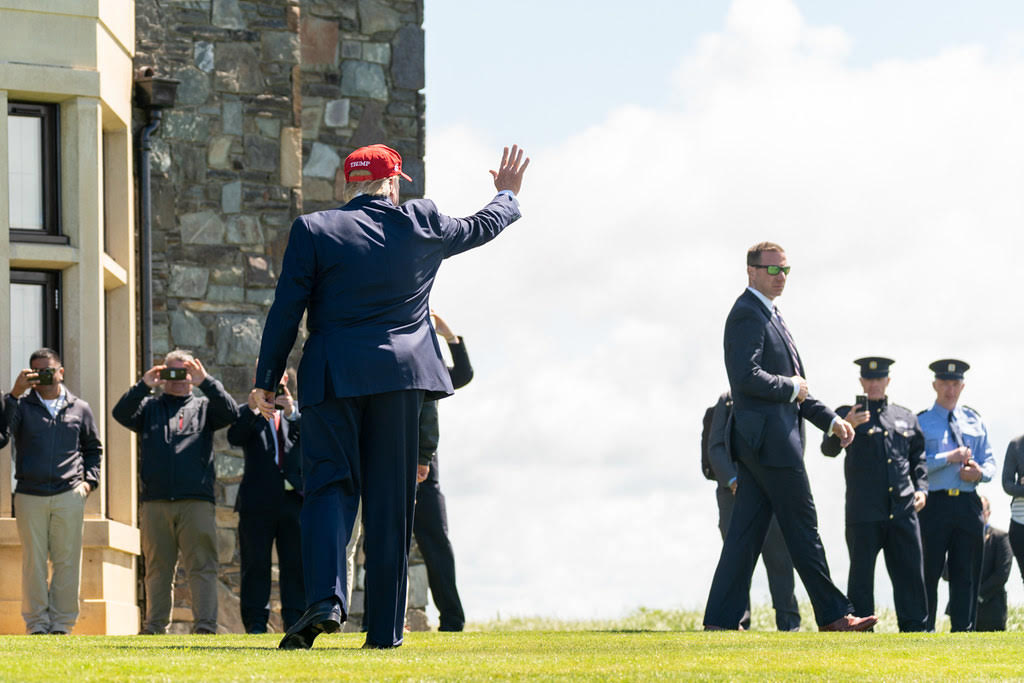
Trump loves Ireland; he loves Ireland so much he has a golf course here. He loves Ireland so much it’s probably his favourite island, well perhaps his second favourite island. Nevertheless, he isn’t wrong: the US and Ireland have a long, storied relationship. Everyone knows about the infamous Irish-American who goes on and on about how much they love “Eyer-land”, but what is rarely discussed is the Irish adoration of America.
Ireland isn’t a particularly “European” country, at least not culturally. It feels more accurate to describe ourselves as an island in the middle of the Atlantic, somewhere between Britain and America. A tightly kept secret of contemporary Irish life is that, to a certain degree, you have to choose which of our anglophone neighbours you are going to emulate. Personally, while I am enormously proud of my country, I can admit that on some level, I am American.

My first encounter with America came in the pub where my family would go out for dinner as a child. Framed on the walls are the newspaper broadsheets from important moments in Irish history. The one that always stuck out to me read “KENNEDY IS ASSASSINATED” in bold black lettering that was noticeably larger than any other headline on the wall, followed by a sombre “Ireland has lost a great friend”. I always wondered why the death of an American President was deemed a significant moment in Irish history by my local publican. Why exactly did we care so much?
JFK’s 1963 visit to Ireland was a moment of pride for Ireland. Not only because he was the first serving US president to visit the Republic, affirming our newfound status as an independent nation, but also because JFK was the first Catholic President and a proud Irish-American. This was in a time when the WASP class controlled everything in American soceity and Irishness had only relatively recently been folded into the accepted definition of whiteness.
JFK simultaneously represented two distinct versions of Irish identity. On one hand, he was a vestige of the past, a representative of every Irish person who was forced to leave behind everything and everyone they had ever loved for a better life abroad. JFK’s “return” as a wealthy, successful, respected man symbolically mended the scars left on the hearts of many Irish families by emigration. If you didn’t know what happened to your brother, your daughter or your cousin, you did now. When he made it, we all made it.
On the other hand, he also represented a bold, unusually hopeful vision for the future. Here was an “Irish” man who was suave, charming, articulate and the leader of the free world. If this is what the Kennedys of Wexford achieved after they left behind the colonial legacy of poverty and destitution, what would we all achieve as we collectively left that behind in forging a new Ireland? It wasn’t certain, but it was a possibility, and that was more than Irish people had ever had.
It is no wonder then that such hurt was felt by the Irish following JFK’s assassination. Following the destruction of Nelson’s Pillar in 1966, it was suggested that a statue of Kennedy be erected in its place on O’Connell Street; other potential candidates included Pádraig Pearse and Jim Larkin, as well as the Virgin Mary.
Across from a statue of the Virgin Mary in a Mayo church this past April, Fr Christoper Ginnelly led his congregation in prayer: “…wars are taking place, which is just absolutely outrageous. We pray for peace for the world; we pray for Donald Trump, and the Lord will take him.” While Fr Ginnelly clarified that he meant that God would take away Trump’s “anger and pain”, the laughter which followed his slip of the tongue reveals just how far America has fallen in Irish eyes. Compared to JFK, the only effigies on O’Connell Street of this U.S. President are the inflatable ones of him being sodomised by Benjamin Netanyahu and Jeffrey Epstein.
Trump represents every dark impulse of the American instinct. His ideology and administration can be surmised as violence of every kind imaginable. America no longer represents hope and a vast unfurling of opportunity but a ranking dread and the narrowing of my life’s possibilities. Through our desire to emulate an American image of success, we abandoned the socialist republic that our forebears died for. Gone is the idea of a nation designed for and by Irish people. Gone is the idea of the state ensuring that never again would we have to live in abject poverty for the benefit of another nation or suffer the humiliation of having to emigrate in order to live a decent life. Our country is not our own.
Our entire fiscal policy is based around collecting as much tax from Irish citizens as possible while building little infrastructure for them, while collecting as little tax from American multinationals (If any at all in the case of Apple) while tailoring our development as a nation to their interests. There is no money for public infrastructure or housing of any kind, but there is plenty of money to host American football games, which literally no one asked for. My children will not grow up alongside my friends’ children the way our parents did. Like the Irish of old, we will have to emigrate in order to have any decent quality of life. My children will know nothing of my home or my people. My pacifist socialist female president is forced to shake hands with a twice-adjudicated rapist to protect these economic interests. All she can do is implicitly ask him to stop slaughtering innocent children in Gaza by giving him poems he won’t read. This is what our notion of sovereignty is reduced to. Whenever I see an American flag, I am disgusted, and this saddens me. It reminds me of when I was told that my favourite cartoons weren’t real and that the voices I loved so much were just old men saying silly things they didn’t believe to make money.
As a child, what drew me to America was its ideals of a new world, where you can express yourself however you want, where you could move past everything that came before and start a new life, where hard work and the truth mattered, and where everyone was treated equally and fairly. A nation founded in reverence for human dignity. I know that these ideals were never actualised for people who don’t look like me, but I still believe these are among the best ideals humanity has to offer. I grew up wishing I was American, and hopefully one day the Americans will decide they want to be American again too.