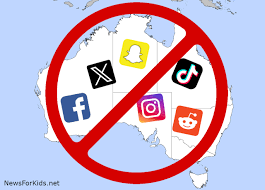
The Australian Online Safety Amendment (Social Media Minimum Age) Bill came into effect on 10th December 2025. This bill prohibits anyone under 16 from having or making accounts on social media apps like TikTok, Instagram, YouTube, Snapchat, X, Facebook and more. This law disallows parents from giving their consent to under-16s to use these platforms. Prime Minister Anthony Albanese has praised the law as a world-first attempt to shield young teens from the mental health detriments and potential abuses of social media
The ban does not punish the children or parents for infringing the ban. Rather, it is the social media companies’ duty to make sure under-16s are not creating accounts. Therefore, social media companies are responsible for keeping kids off their platforms through age assurance technologies: government IDs, face or voice recognition, or so-called age inference technologies that analyse online behaviour and interaction to estimate the user’s age. These companies could face fines of up to A$49.5 million for serious or repeated breaches of this law.
Meta, the parent company of Instagram and Facebook, has already said it removed almost 550,000 accounts belonging to children under 16 before the ban came into effect. A month after the law came into effect, nearly five million social media accounts belonging to Australian teenagers had been deactivated or removed.

Some opponents of the law have voiced worries concerning possible VPN downloads that could allow under-16s to have social media access and the migration to other apps not covered by the ban. VPN downloads, an online tool that hides users’ locations to bypass country-specific restrictions, increased before the ban. However, it seems that downloads have now fallen back to normal. In addition, social media platforms are expected to detect VPNs as part of the law. Furthermore, while there was an initial spike in downloads of other social media applications, there has been no sustained uptick in their usage.
Julie Inman Grant, the eSafety Commissioner, acknowledged there would probably still be some underage teenagers who manage to be on social media despite the ban. Nonetheless, she argues that the law’s success should be measured by a broader reduction in harm. “Speed limits, for instance, are not a failure because some people speed”, she said. “Most would agree that roads are safer because of them”.
This bill has already been quite a success during the first few months of its coming into effect, with the number of social media accounts being deleted. Although the full changes it has on the youth will not become completely apparent until the next generation that is raised with the ban in effect, from the statistics gathered for now, it is clear that it is the first step in bettering the lives of Australian children.
However, further measures need to be taken to fully assure the ban’s success. Not only should access to social media accounts be prohibited for under-16s, but the government should either collaborate or compel social media enterprises to ensure safe and controlled content on their sites. This would mean the removal of aggressive, harmful and sexual content from social media for all ages. This way, if children somehow manage to gain access to a social media account despite the ban, the content they would have access to would be the least harmful possible.
Not only this, but it is crucial to understand that teenage social relationships have been formed and shifted by social media. Indeed, children who live in remote areas or have difficulties socialising in real life have created social communities and connections online. Thus, it is necessary to create teenage social communities within and outside of school to fill in that social gap that social media has filled in recent years. Clubs, sports, societies and reading groups could become third spaces for teenagers to interact with each other and build relationships. Further investment in local libraries, parks and schools is crucial for this law to fully reach its potential. Not only this, but the implementation of educational programmes and affordable counselling in schools is also vital. This would aid teenagers as they come of age to navigate this transition through education on safe social media usage.
It won’t be easy, and it will necessitate time and investment, but it is possible. Social media bans are a confident first step that, if followed by further action, could be a radical positive change in teenagers’ lives.