
A year after Time Magazine declared that Generation Z is drinking less than their predecessors, Business Insider made its rebuttal, proclaiming in July of this year that “Gen-Z is in their alcohol era”. The pieces make for a conflicting consensus on the younger generations’ nightlife habits amidst a prescribed “Epidemic of Loneliness” — correlated in part to a decrease in in-person socialising, according to a 2023 study.
Nonetheless, the argument that Gen Z is drinking less persists and is not confined to the American youth referenced in the aforementioned articles. Innova Market Insights, in the same month Business Insider proclaimed otherwise, wrote that Gen Z in Europe make up for “the lowest level of alcohol intake of any generation”. That’s not to say those born after 1997 are practising complete abstinence, but that a myriad of factors — including rising costs — may have contributed to a shift in behaviour.
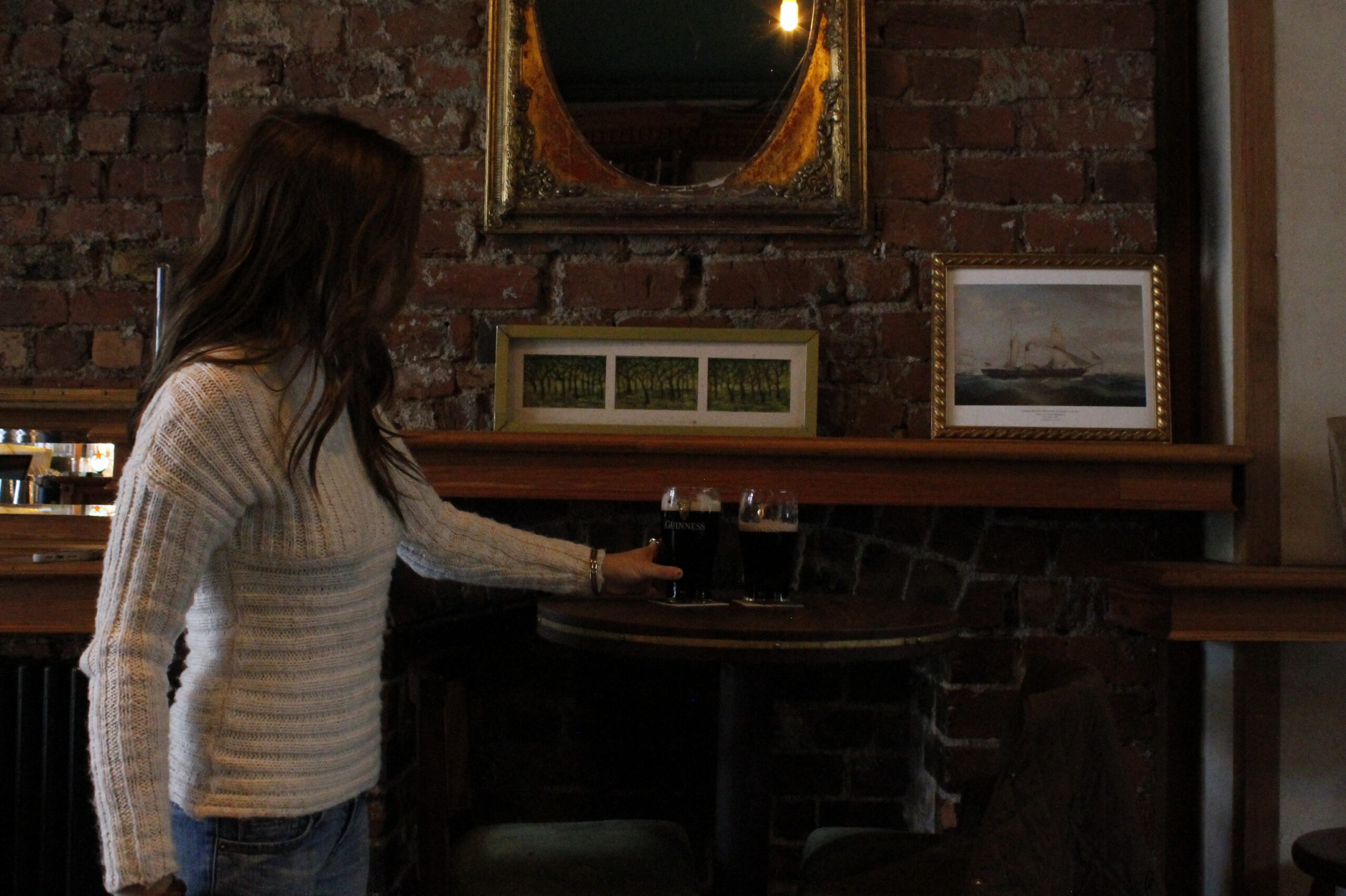
But what about here, in Ireland, where pub culture has become near synonymous with the nation, and Dublin students are no strangers to the barstools of Doyle’s (among many others) and Trinity’s very own Pavilion Bar? If the young generation in Dublin are choosing to drink less, or not at all, what spaces are available to them?

“I definitely feel like there’s a lot in Dublin to do even if you don’t drink”, said Amelia Robinson, a Senior Fresh student in History and Ancient History and Archaeology.
Robinson made the personal choice not to drink before coming to college — but she said it hasn’t hindered her social life.
“I love dancing and just like hanging out and meeting new people. And it doesn’t really feel like I have to drink to do that…I feel like I’ve had like plenty of fun at college just doing what I’ve been doing, so I’m not too stressed about it”, she remarked.
As it would turn out, the division between the non-drinker and the pub may be a thing of the past. Going to clubs and pubs is still part of Robinson’s social routine, and not drinking hasn’t negatively affected her college experience, she said.
Robinson’s testimony may be indicative of a new relationship between Gen Z and the pub. Perhaps, for the first time, the non-drinking demographic is not at odds with the pub space.
Social infrastructure is one of the facets in the 2023 study that contributes to “community health”. Third places are a key way social infrastructure can help communities thrive, defined by sociologist Ray Oldenburg as “local gathering places, where people who live and/or work in the area gather regularly, informally, inexpensively and comfortably”. This infrastructure, or third place, may have been right under our noses this entire time, in the form of the public house.
Rounds of Thought is a newly launched series that brings together field professionals to deliver lectures in pubs, offering a space to engage with new ideas outside of a lecture hall. While pub lectures have been seen across cities and countries – Lectures on Tap across the USA, Pints of Knowledge in the UK — this brings an iteration of the pub lecture to Dublin.
“There’s a growing interest for experiences beyond the traditional night out”, said a spokesperson from Rounds of Thought in a statement to the University Times.
“The social element [became] a key part of what Rounds of Thought is about: putting the phone down, pulling up a chair and creating a space where people can learn something new while meeting and talking to the people around them.”
There is an element of choice in the pub lecture, with an equally balanced emphasis on both the social aspect of pub culture itself and the educational potential of a lecture. With equal parts drinking and non-drinking atmosphere — and conversation at its heart — Rounds of Thought and events like it could open the table to a wider range of people.
Further, with pubs shutting down across Ireland due to rising costs and changing behaviour, perhaps broadening their target demographic could benefit both industry and community health. According to the Irish Times, more than 2,000 pubs in Ireland have closed shop since 2005, with many more at risk.
While the Atlantic Magazine recently decried that “the anti-social century has come to campus”, with students spending less time socialising on average than previous generations, one can’t help but wonder: could one of Ireland’s most ageless traditions be a remedy for the prescribed problem? For those both opting in and out of alcoholic beverages, the nature of the pub — to pull up a stool, meet a stranger, flex one’s social muscle and perhaps learn something new — could take on a new value.
The word “pub” stems from “public house”. Donal Fallon, author of The Dublin Pub, noted in an interview with the Guardian that there is a “real warmth in that term. It implies a shared space and a living space. It captures the collective sense of what a pub is.”
Allowing for the return of the social and intellectual culture of the pub as a space where communities can connect — whether over a pint or a presentation — Dublin’s youth may start to consider the public house their third place.