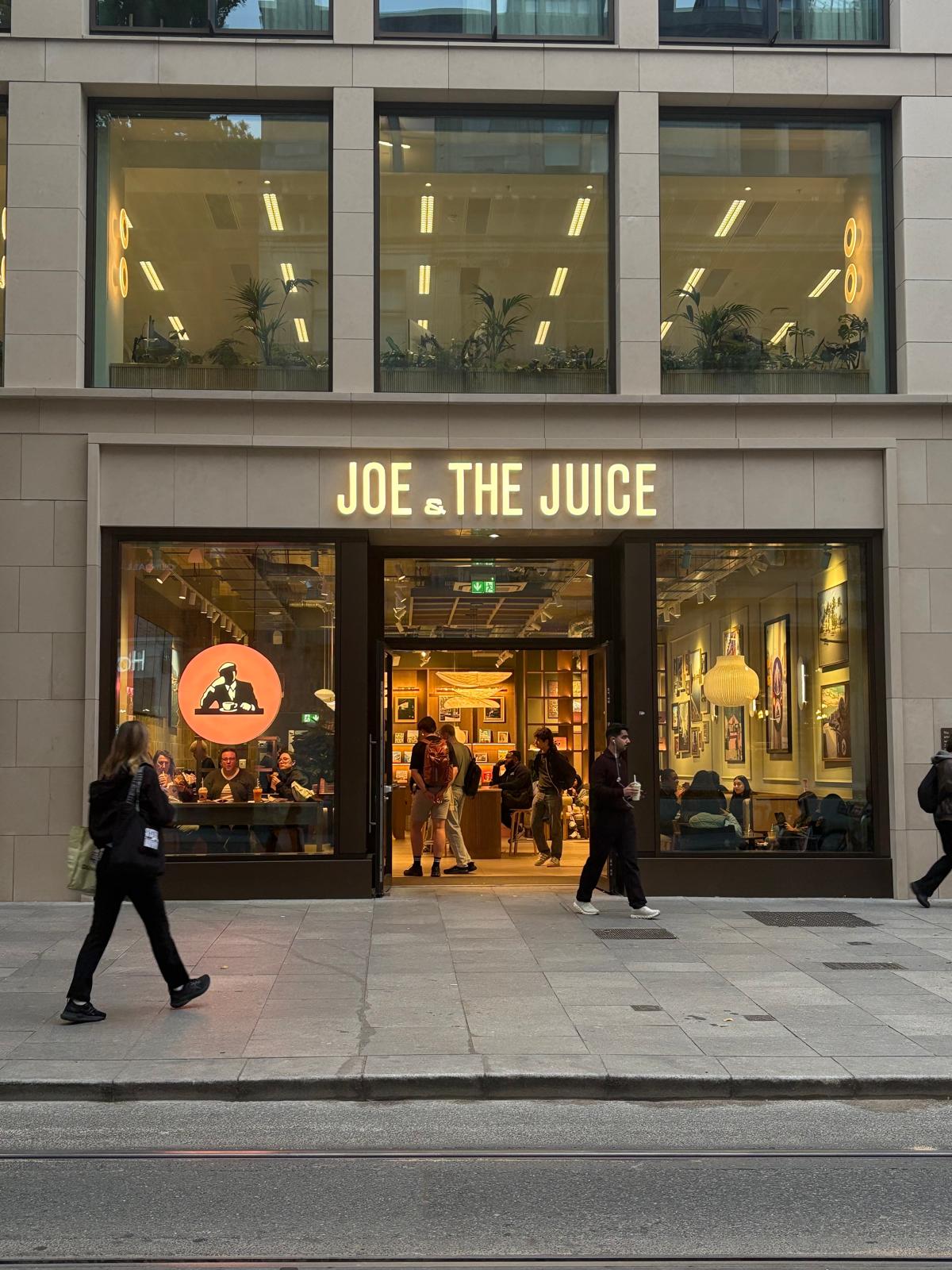

At the beginning of summer, the Danish café company Joe & The Juice opened its first Irish location on Dawson Street, and it is the first of many shops the company aims to open around the country before the end of 2026, according to Ben Stinley, who works in the marketing section of Joe & The Juice. For example, more recently, as reported by the University Times, a second location of the café is set to open in place of Brother Hubbard, in Arnotts. Joe & The Juice has more than 500 locations worldwide, and it emphasises healthy offerings, including juices, smoothies, matcha, and salads. The major shareholder in Joe & The Juice is the private equity firm General Atlantic, known for its long-standing investment links with Israel. General Atlantic waited to get involved in Israel’s economy until it saw a growing pattern of Israeli companies raising $100 million in a funding round; consequently, the arrival of General Atlantic gave credibility to Israel as a country with a greater number of large tech firms.
In this context, it should be considered that only recently, on July 23rd, the Israeli Settlements in the Occupied Palestinian Territory (Prohibition of Importation of Goods) Act of 2026 has been enacted, prohibiting imports originating in illegal Israeli settlements. This law is deliberately limited to goods, rather than extending it to services more broadly, thus leaving untouched cases like Joe & The Juice, despite its funding and investments being intrinsically linked to Israel all the same.
This does not come as a surprise, given the amount of benefits Ireland receives from foreign companies with operations in Ireland. In 2022, foreign-owned companies employed around 620,000 people in Ireland and accounted for 921 billion euros of total turnover. These companies represented just 3.2 per cent of total businesses in the country, yet produced 71.4 per cent of total turnover and employed 27 per cent of workers. Therefore, when the opportunity arises for a company like Joe & The Juice, where in 2025 its total revenue grew 16.5 per cent and roughly reached €442 million in total, profit is inevitable. This, combined with the fact that the tourism sector in Ireland has remarkably grown these first six months of 2026 (13 per cent), points to an underlying aim to create revenue from foreign companies that profit especially from tourists. As Kate English, Deloitte’s economist, said: “The data reaffirms that foreign-directed investment (FDI) is a crucial driver of Ireland’s economic growth.”

Hence, foreign-owned companies are crucial in Ireland’s economic paradigm, which deeply compromises its stance and position with Palestine. This is so because the current globalised economic system has created a structure that favours revenue and profit from foreign-owned companies, regardless of its stance with Israel or Palestine. This shows how the current economic structure of Ireland is incompatible with full political sympathy and loyalty to Palestine, because financial earnings cannot supersede this political alliance, which explains the limitations of the aforementioned policy.
In fact, Alex Crisses, the general director at General Atlantic, claimed that criticisms of Benjamin Netanyahu’s government in Israel are unlikely to affect General Atlantic’s investment plans, a staggering example of how a globalised economy makes it impossible, or very implausible, for countries to fully cut ties with Israel without suffering financially, hence leaving a clean leeway for firms like General Atlantic.
This is especially true in the case of Ireland, where the economic well-being of the country depends heavily on foreign-owned enterprises, which, in the case of Joe & The Juice, have intrinsic ties with Israel. While the Israeli Settlements Act 2026 is a good starting point, the Irish government would need to extend its distancing from Israeli companies not only by prohibiting the import of goods but also by altogether cutting all ties with Israeli-owned and -financed businesses. Otherwise, Ireland’s stance with Palestine becomes at best a modest move towards ending Israel’s allyship and at worst a mere legal façade with no strong impact on Israel’s power.