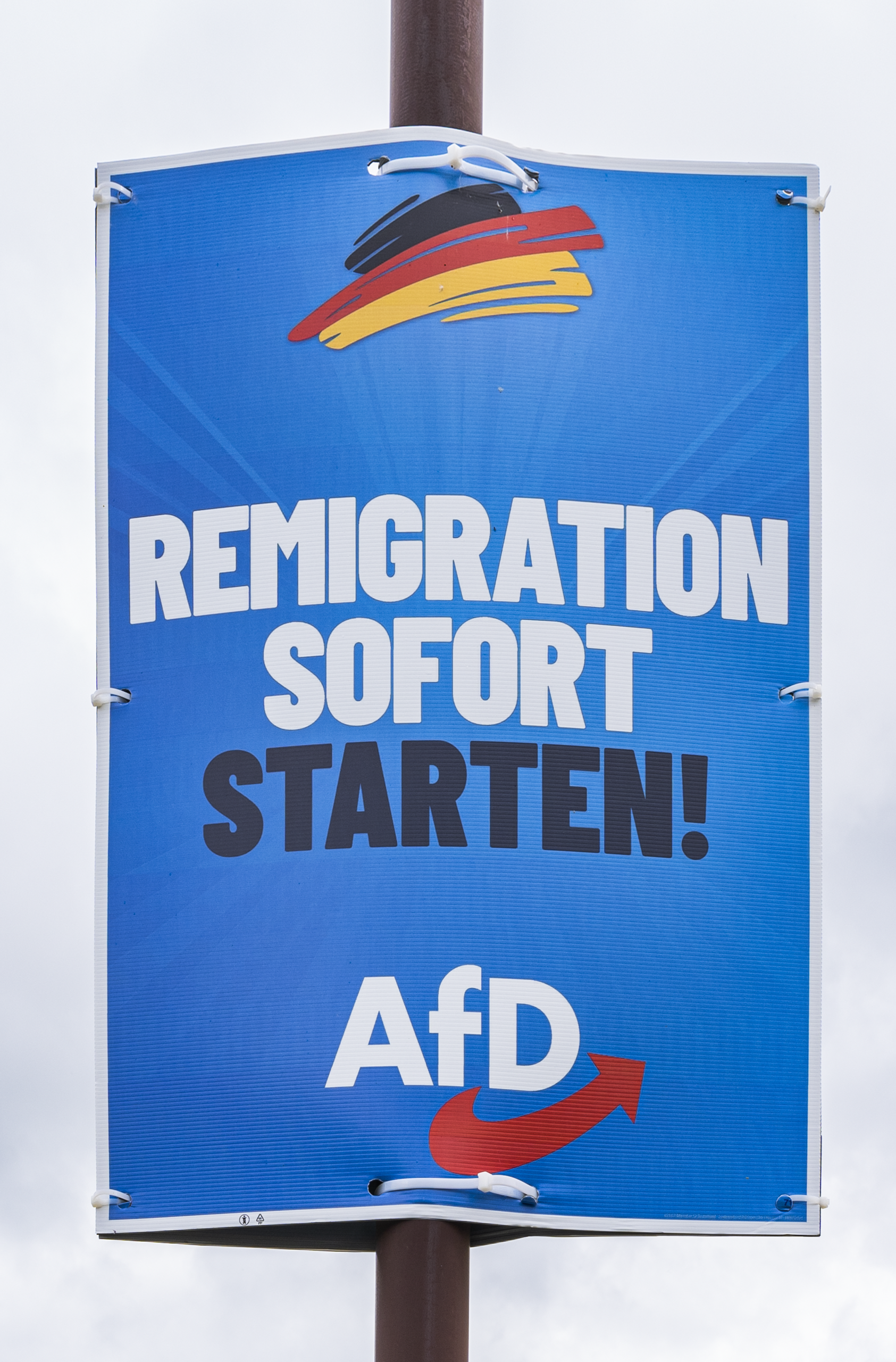

The Alternative for Germany (AfD) is a Euro-sceptic, populist, right-wing party with ties to neo-Nazi organisations. Their platform can be understood as ethno-nationalist and ultraconservative. It envisions a “Germany for Germans,” is viciously anti-migrant and anti-Muslim, and staunchly opposed to same-sex marriage and feminism. As of 2025, the AfD is the second largest party in parliament with 20.8 per cent of the vote.
In a recent state-level election in Sachsen-Anhalt (in former East Germany), the AfD reached its highest vote on record with 43.8 per cent, only nearly missing an absolute majority. This victory marks the first time that a German state could be controlled by a far-right party since the fall of the Third Reich in 1945. On Sunday, the AfD won another federal state’s majority with 38,2 percent of the vote in Mecklenburg-Vorpommern. In Berlin, where elections were held on the same day, the left-wing “Die Linke” was elected as the state’s strongest party. Nevertheless, the AfD garnered 16.3 per cent of the vote, a 7.2 per cent increase since 2023, an alarming result given that Berlin is considered a progressive stronghold in Germany.
While there has been a notable shift towards right-wing populism across Europe in recent years, there is something particularly alarming about its success in Germany. This “politics of resentment” — of trying to name and direct anger towards the nebulous “outsiders” and “elites” — cannot help but flirt with the symbols and paroles of the Nazi past. Sometimes, explicitly so, by questioning whether we should see Hitler as “absolutely evil” (interview with Björn Höcke) or by suggesting that given the amount of foreigners in the country, “a Holocaust may be worthwhile again” (leaked chat messages by former parliament staffer Marcel Grauf). AfD party leaders frequently downplay Holocaust remembrance by referring to it as a “culture of shame” (Höcke), or euphemise National Socialism as “just a speck of bird shit in over 1,000 years of successful German history” (Alexander Gauland). These statements, while extreme, are rooted in the AfD’s larger project of reclaiming “German pride” and protecting “German culture” from outsiders and shame about its Nazi past.

But the AfD itself actively invokes the past they claim to be trying to escape. In 2023, right-wing extremists (amongst them multiple AfD politicians) gathered for a secret meeting in Potsdam to discuss “remigration,” the forced expulsion of millions of people with a migrant background. Both the place in which the extremists gathered and the plan they discussed there have a significant history. “Remigration” is a term often linked to Nazi-era ethnicity-based ideas of nationhood; the hotel in which the extremists discussed it is located only 8km away from the “Haus der Wannseekonferenz” in which the Nazis coordinated the systematic annihilation of Jews. As of 2025, “remigration” is officially a part of the AfD’s party programme.
The AfD embraces extremism; so do its followers. It is not uncommon to find AfD followers shouting slogans like “Sieg Heil” or displaying symbols that reference Nazism at rallies, both of which are illegal in Germany. Germany’s domestic intelligence service has reported that the number of right-wing extremists has significantly grown in the last few years, reaching 58,700 in 2025. They attribute a large part of this growth to the AfD, whose membership reached 70,000 in the same year. There has also been a corresponding increase in extremism. In 2025, 36,951 criminal offences (some of which were violent in nature) were registered by Germany’s federal domestic intelligence agency, a number that has increased exponentially over the last few years.
A party like the AfD should not be able to hold the power that it does in Germany because the German constitution was literally designed to prevent it. Created after WWII in order to preempt another fascist government, the constitution envisions Germany as a “fortified democracy,” which upholds its own democratic order through protective mechanisms like the “Verfassungsschutz” and informal agreements like the “firewall coalition” (which works when democratic parties form a cross-spectrum coalition to isolate and thus limit the power of extremist parties such as the AfD). But these mechanisms seem to be failing.
Since its founding, the AfD has been closely monitored by the German “Verfassungsschutz” (the federal constitutional protection agency). In 2025, they officially ruled that the party is right-wing extremist, meaning its ideology is fundamentally incompatible with the free democratic basic order. This classification — which is currently being contested by the AfD in state-level courts — is based on “the extremist nature of the party as a whole, which disregards human dignity” and its “prevailing view of the people based on ethnicity and ancestry.” In response, Ulrich Siegmund, the party leader of the AfD’s Sachsen-Anhalt chapter, has said that he could imagine abolishing the state-level Verfassungsschutz if his party holds an electoral majority.
The firewall operates to limit the AfD’s power within Germany’s multiparty system, but this approach only works when the AfD is small enough to rely on outside parties to support its policies and votes. Their recent wins suggest that mainstream democratic parties may no longer be in a position to limit the AfD’s power, and instead seem to be struggling to compete with the AfD’s success.
Germany’s democratic turmoil should be raising alarms across Europe. We have seen what can happen here in the past, and if parties like the AfD manage to rewrite German history and abuse the democratic order, we could be damned to repeat it.