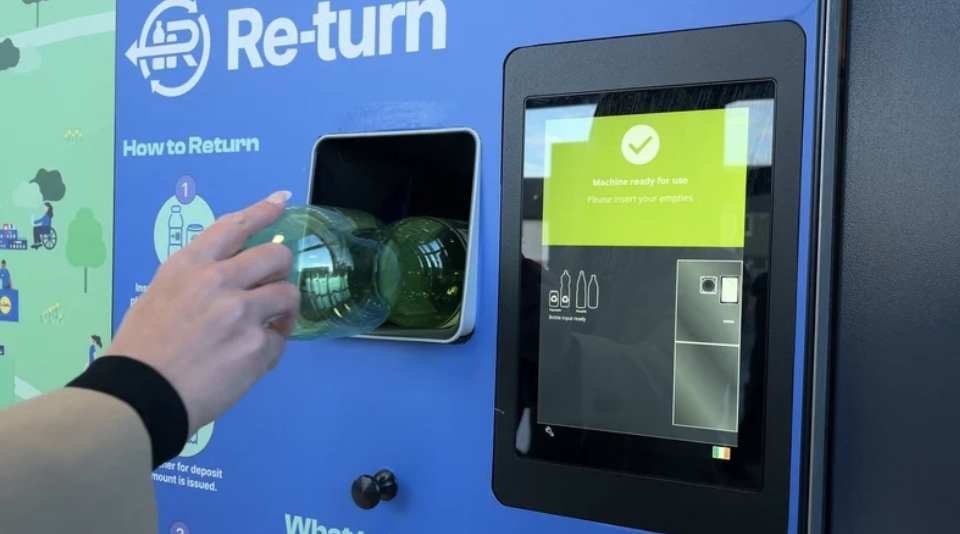

The bottle return scheme has won in the marketplace of ideas. A man can proclaim the Christian gospel or Gramsci’s critiques of capitalism and yet remain a respectable middle-class academic. But lay a finger on container-deposit legislation, and you are sure to provoke the eunuchs of bourgeois culture.
Why should this be so? It is a testament to the scheme’s success that opponents of it are asked to justify themselves, as though one would need a reason to oppose an extra 0.15¢ on all canned and bottled beverages.
The policy has a long history beginning with private ventures of the sort during the heady days of the Protestant Ascendancy. Evidently, bottle return provided an outlet then, as now, for men like the right Reverend Bishop Berkeley to (green)wash their hands of their crimes through ethical consumption.

Fundamentally, the bottle-return scheme imposes either a sales tax, or a piece-wage, depending on the response of the consumer.
It is a sales tax if the bottles are not returned. Some may erroneously believe that, if returned, the scheme provides a discount. This is false: not only is it an extra cost placed on the beverages, but since the revenue goes to the Irish state, private businesses have no incentive to lower the retail price.
Sales taxes, in general, harm lower- and middle-income individuals more than people with higher salaries, as the former spend a greater proportion of their money on consumption. This is also because the bottle-return scheme raises beverage prices by a fixed amount by container, in a somewhat analogous way to the tobacco products tax.
Nor is it a small price. In 2024, Irish consumers spent an extra €67 million in unredeemed “deposits”.
I do not advocate that all taxes on consumption should be opposed. The tobacco products tax, though in my view exorbitant, has the justifiable distinction of taxing consumption to prohibit consumption as a whole, by preventing people from picking up the habit of smoking. We should turn then to the flipside of the scheme — the repayment upon returning the empty bottle.
Economically, the scheme functions then as a piece-wage. While time-wages pay by the hour, piece-wages are proportionate to a given commodity of labour, such as with art commissions. Here, the labour is the collection and return of the bottles. For time is a fundamental opportunity cost — the deprival of the next best option — and there is no doubt that capitalising on the bottle return scheme takes far more time than conscientious recycling. If seen as piece-wages, the labour is compensated for an amount far below the national minimum wage, unless someone were able to collect and return an astonishing 90 untarnished bottles per hour.
This demonstrates the falsity of the view that it is beneficial for the homeless and impoverished. A fairer and juster way to protect the environment while providing work would be to hire people, at a legal wage, to collect bottles for recycling. The way the scheme works, however, is essentially by outsourcing cheap labour to the homeless. This can be seen in the shelves surrounding public bins, such as the ones near Nassau Street, where people can leave cans for others to take and turn in. Furthermore, many people litter bottles carelessly, justified on the basis that the homeless can make some money off of it.
The scheme also incentivises the dangerous practice of dumpster diving, which is liable to cause injury or infection. And anyone can attest that many flats and workplaces have become filled with discarded cans. Amy Kennedy, a Junior Sophister English student, notes that at their job the storage space is filled with massive trash bins full of cans and bottles as they are infrequently removed due to the shops closing before the workplace does. Nor does the bottle return scheme work for the businesses which must accommodate it, with the large machines taking up space and requiring extra labour.
The final objection would be that the bottle-return scheme has had great success in encouraging people to recycle who wouldn’t otherwise and that, even with more public maintenance workers, there are more bottles which have been saved from polluting the environment. And this is at least somewhat reasonable.
However, I would argue that in the long run the wiser method would be more ethical encouragement, rather than monetary incentivisation. In a famous study, parents were more likely to be late on picking their children up from daycare if there was a fine. This is because while, without a fine, they were motivated by duty, they felt that with a fine it was a matter of expense. To many wealthy people, the bottle return scheme is simply a small expense that rids them of guilt for the improper disposal of bottles. There is good reason to think public campaigns, and a better distribution of recycling bins, would have a similar effect for bottle pollution.
In conclusion, the bottle return scheme is a waste of time and money among those who have the least to spare. It is not good for businesses and it is not good for consumers. We will never get that time and money back, but we may firmly and piously hope that our children will only read of this “scheme” in the history books as but another injustice from a violent and repressive age.