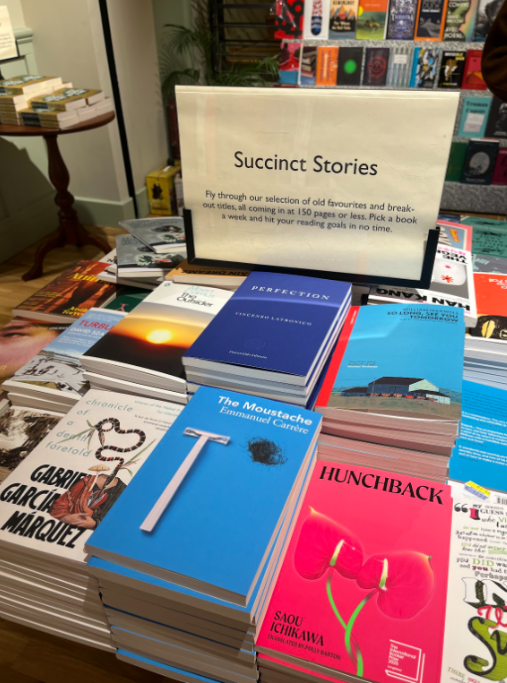

Last Friday, I walked into Hodges Figgis while awaiting my interviewee’s responses for this article and came across a table of books labelled “Succinct Stories”. It would seem that the Hodges Figgis managers and University Times literature editors are in a similar space of mind; both seeking to provide Trinity students with the ideal book for exam season.
From this table, I picked up a book called Assembly by Natasha Brown, which offers a look into the mind of an unnamed young London professional who has become disenchanted with the life she worked so hard to achieve. Worn down by racism, sexism and the overall cutthroat environment of the workplace, our protagonist drifts further and further away from herself as the narrative progresses. Coming in at exactly a hundred pages, I felt this book was ideal for the end of the semester. I was totally absorbed by each fragmented narrative thread offered to me, but the fractured nature of the story means the book is easy to dip in and out of if desired. This novella read to me like a modern retelling of Margaret Atwoord’s debut novel The Edible Woman.
Here is what some other students are reading as the semester draws to a close.

Kafka Was The Rage by Anatole Broyard – Roan, 3rd year English
It is the author’s memoir of moving to Greenwich Village in New York after serving in WW2. Great prose, semi-graphic love scenes, name-dropping of a lot of great writers.
Truly one of the most-enjoyable books I have read recently, and what I love most about this memoir is the simplicity of Broyard’s writing. He describes this period of his life in such clear yet revealing terms, the effect is that of a friend recounting a story for you after not having seen them in a while. It helps that these stories are about books, jazz and sex, with the sense of a conversation strengthened by the richness of the subject about which the author writes.
This book is such a simple yet engrossing read. I typically pick it up in the morning for something to read over breakfast, just to get my brain working first-thing. Given that I study English, most of my time during exam season is spent reading, not only books themselves but also endless secondary materials and articles. Needless to say, going home to pick up a book is not the first thing one might think of. Having something to read that demands so little of the reader while simultaneously offering so much richness and levity is a welcome opportunity to read for pleasure in the midst of so much reading for college.
There used to be a cafe called Kafka next to my house, but it closed, so now I’m unhappy that I can’t go to Kafka and read my book called Kafka Was the Rage. First-world problems.
Watt by Samuel Beckett – Daire, 4th year Theoretical Physics
Daire is currently reading Watt by Samuel Beckett, which he describes as a “novel about a pointless existence.” When asked if he would recommend the book to others, Daire said he would only recommend it to someone with “nothing else to read.” “The main criticism I have for the book is that the minor elements of absurdism do little to abstract from the main narrative of the book – or the lack of it.” As someone who has just finished writing a dissertation on Samuel Beckett, I find it hard to imagine turning to the elusive playwright in order to unwind, but Daire says this book is “suitable” for exam season, as “you will not be meaningfully distracted by it” and “it is also fairly short”. However, overall, Daire’s impressions were negative: it “was not a good first impression of Samuel Beckett’s writing”, he shared.
News From Nowhere and Other Writings by William Morris – Helena, 3rd year History
A collection of William Morris’s fiction and non-fiction, including lectures, letters and short stories, which are all connected by the Arts and Crafts theme. The most important text, News From Nowhere, is a utopia in which the protagonist wakes up in a nostalgic vision of a London transformed by revolution, where people live and work contently.
It is a very comprehensive collection that gives an overview of the ideas behind the Arts and Crafts movement. News From Nowhere is perhaps better read for the ideas than the storytelling. Morris’s utopia is flawed in many ways, but I find the medium very interesting as it says a lot about the mindset of people in the late 19th century.
Because I picked it up for a potential dissertation idea, it has not really served as a distraction so much as another kind of studying. At the same time, because it is a collection of different writings it is easy to dip in and out of when I have the time.