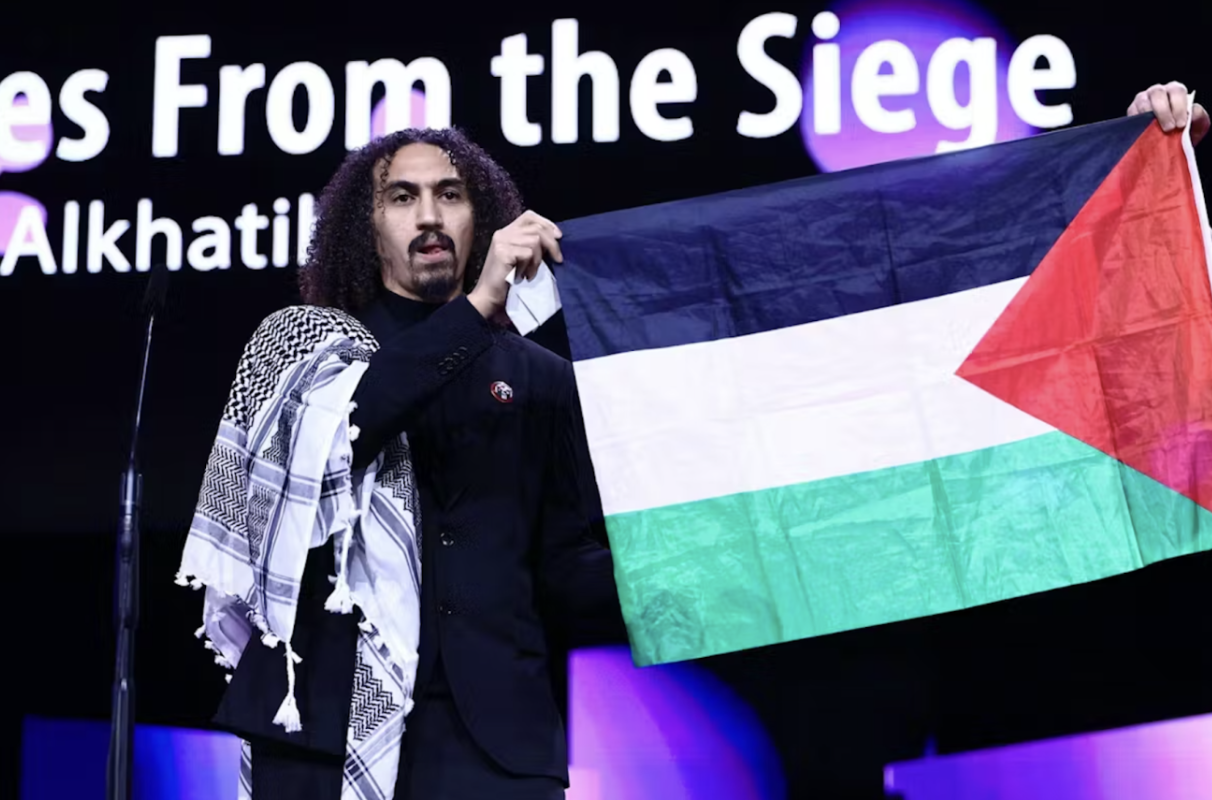

This year’s Berlin International Film Festival took an unwanted political turn. After journalists inquired about the Berlinale’s conspicuous silence towards Germany’s complicity in the ongoing atrocities in Gaza, the competition jury responded with jaded indifference. Polish producer Ewa Puszczyńska claimed the question was unfair, and that “there are many other wars where genocide is committed, and we do not talk about that”. Jury president and acclaimed German director Wim Wenders supported Puszczyńska’s point, remarking that film is “the counterweight of politics… the opposite of politics”. While these attempts at evading this political question were met with scattered, polite applause, the discourse roaring in the conference’s aftermath is drowning out their apoliticism.
In line with the journalist, critics remarked that the Berlinale has been explicitly political in the past. In 2023, the festival stood unabashedly in solidarity with Iran and Ukraine, even colouring their trademark bear pins blue and yellow for the latter. In 2024, the festival awarded “No Other Land”, a Palestinian–Israeli documentary showcasing the displacement of Palestinians within the Israeli-occupied West Bank, with the Documentary Award, and when the festival received backlash for the decision from German government officials, they stood firmly behind the film.
Eighty members of the film industry (including actor Brian Cox and Berlinale regular Tilda Swinton) reiterated this hypocrisy in an open letter published on February 17th, stating that they were disgusted with the Berlinale’s “institutional silence” on Gaza. Furthermore, they “fervently disagree[d]” with Wenders’s statement differentiating film and politics. They asserted that “you cannot separate one from the other”. Curiously, Berlinale head Tricia Tuttle seems to agree, albeit with certain reservations.

In response to the rising controversy, Tuttle expressed that filmmakers are expected to answer political questions, and “they are criticized if they cannot compress complex thoughts into a brief sound bite… when they thought they were speaking about something else.” She further lamented that “in a media environment dominated by crisis, there is less oxygen left for serious conversation about film or culture at all, unless it can be folded as well into a news agenda”. As for the content of the films themselves, “some films express a politics with a small ‘p’: they examine power in daily life, who and what is seen or unseen, included or excluded. Others engage with Politics with a capital ‘P’: governments, state policy, institutions of power and justice… Speaking to power happens in visible ways, and sometimes in quieter personal ones.” Tuttle mentioned that there were multiple films in this year’s programme “about genocide, about sexual violence in war, about corruption, about patriarchal violence, about colonialism or abusive state power”. If the films speak for themselves, what’s the use of words?
Rather than capitulating entirely to the critics’s point that art is inherently political and that artists then have a moral imperative to speak about political issues, Tuttle’s statement is instead a searing indictment of the increasingly politicised red carpet. She is correct to note that the expectation that every filmmaker or actor must be well rehearsed activists with good politics is a fanciful distraction from the art and the political matters at hand. Even the Ukrainian coloured bear pins from the Berlinale’s past signal a certain performative activism that is cynically futile at worst and vacuously virtuous at best. The expectation of explicit political speech is ultimately infantilizing and in bad faith. It doesn’t treat artists as the politically conscious disseminators they are, and it undermines the viewer’s intelligence in their ability to discern political messages — speaking to power can be amplified through artistry with varying degrees of subtlety. But what is particularly revealing about Tuttle’s statement is that it runs contrary to the apolitical sentiment of the jury conference. It unveils Wenders’s futile attempt at disentangling film from its inherent political nature. Upper or lowercase “P”, cinema is born out of political conditions, and it can choose whether to reinforce or counter them.
What we see with our own eyes has power. Across social media, we are confronted with the rawness of atrocity. Images flash before us of the ashen and flat landscape of Gaza succumbed to rubble, of starving people, bloodied and lifeless bodies, parents and children wailing and mourning the untimely loss of the other. In America, varying angles of Renee Good and Alex Pretti’s senseless murders on otherwise mundane streets flooded algorithms. The cracks of impetuous gunshots and scenes of havoc are seared into the viewer’s consciousness, even if, when asked about creeping Western fascism at the Berlinale, Neil Patrick Harris states that he’s interested in “doing things that are ‘apolitical.’”
While these are real-life, capital “P” political images, politicians are no strangers to fictionalizing and manipulating visual narratives of their own. Former Obama speech writer Sarah Hurwitz discourages young Jewish people from engaging with social media, revealing that attempts at pro-Israel rhetoric are seen “through a wall of dead children”. Trump posts gaudy AI generated footage of himself erected in gold in a transformed Gaza resort, and the Administration opts for an equally artificial yet more subtle doctoration of Minneapolis protestor Nekima Levy Armstrong, portraying her as a hysterical and petulant resistance liberal rather than a stoic and serious protestor.
Filmmakers, politicians and visual disseminators in total are auteurs of the social fabric. Visual media, and cinema as an extension, have an inherent political responsibility to reinforce or challenge dominating narratives. Fiction and documentaries alike use the medium of film as a mechanism to disseminate some form of commentary. It has a stake in explicitly political conversations.
In a response to the Berlinale, director and actor Xavier Dolan released an op-ed for Le Monde, in which he expressed a similar sentiment. He wrote that “In Politics, Aristotle defines the human being as zôon politikon — a ‘political animal,’ that is, ‘a being made to live in an organized community’”. Thus, he concludes, “All art is fundamentally political”, as “it participates in the advancement and care (maintenance of the social fabric) of the community.” Artists “introduce interpretive frameworks that challenge assumptions, fracture the status quo, skew naturalized structures, and unsettle entrenched elites”.
Film is not the “counterweight of politics” in an apolitical sense, but rather a counterweight to the narratives established by political elites. Film is political when the codirector of “No Other Land” Hamdan Ballal was lynched by Israeli settlers and arrested for a film about shared humanity. Film is political when A-listers like Brad Pitt, Joaquin Phoenix, and Spike Lee sign on as executive producers to amplify a film about Israel’s military inhumanity in Gaza, “The Voice of Hind Rajab”.
It is not superfluous or overoptimistic to realize that Wenders was right to say that “movies can change the world.” (A genius can reveal the barest, most honest cliches, too.) Because when the lights turn off in the theater and reality is suspended, when it’s just you and the images on a big screen, you are transported into another consciousness, and it can change who you are as a person, as a citizen. It is an act of empathy, and it is undoubtedly political. Film works as civic education: it teaches us that to be informed, productive citizens, we have to pay attention to what we see.